Duo Therm RV Thermostat Instruction Manual
Duo Therm RV Thermostat






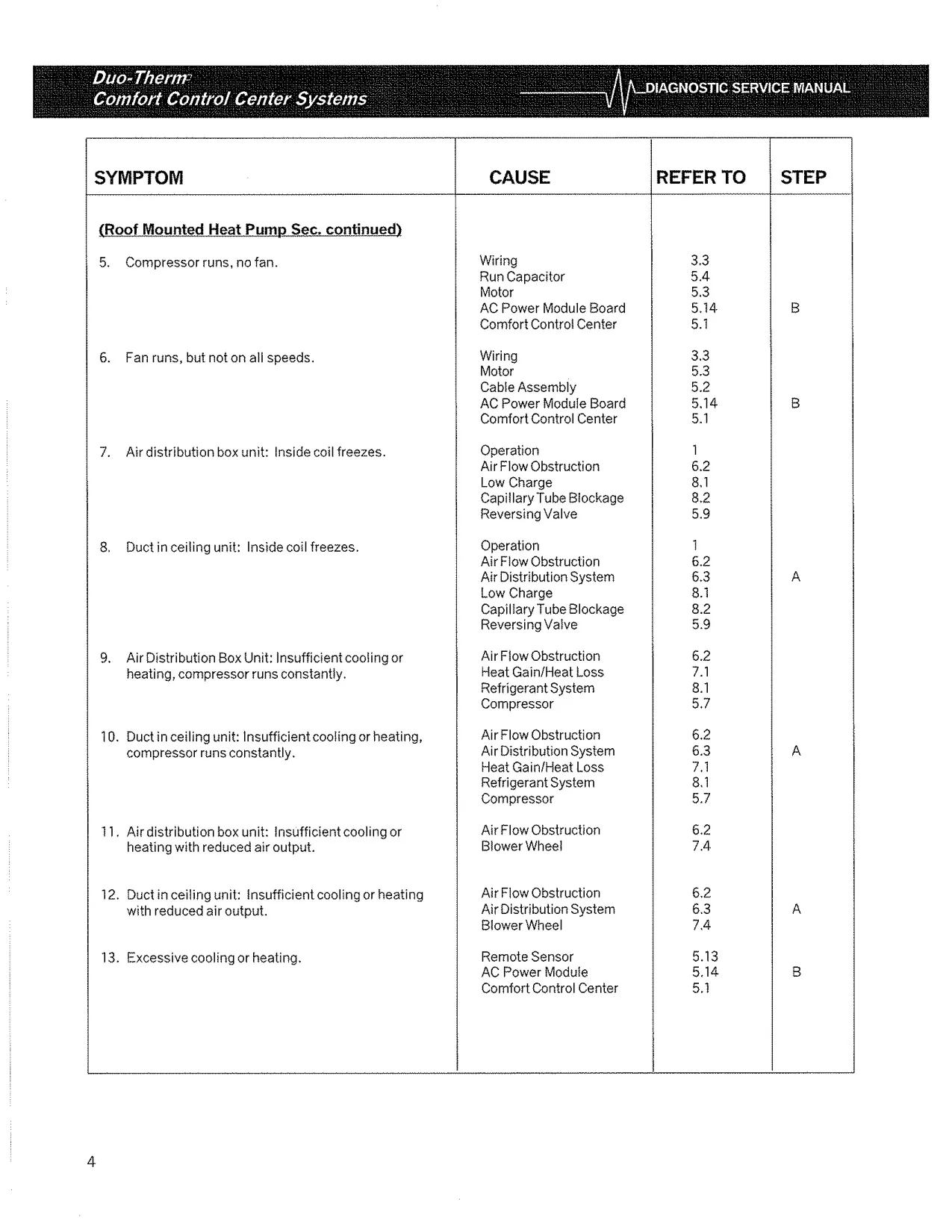

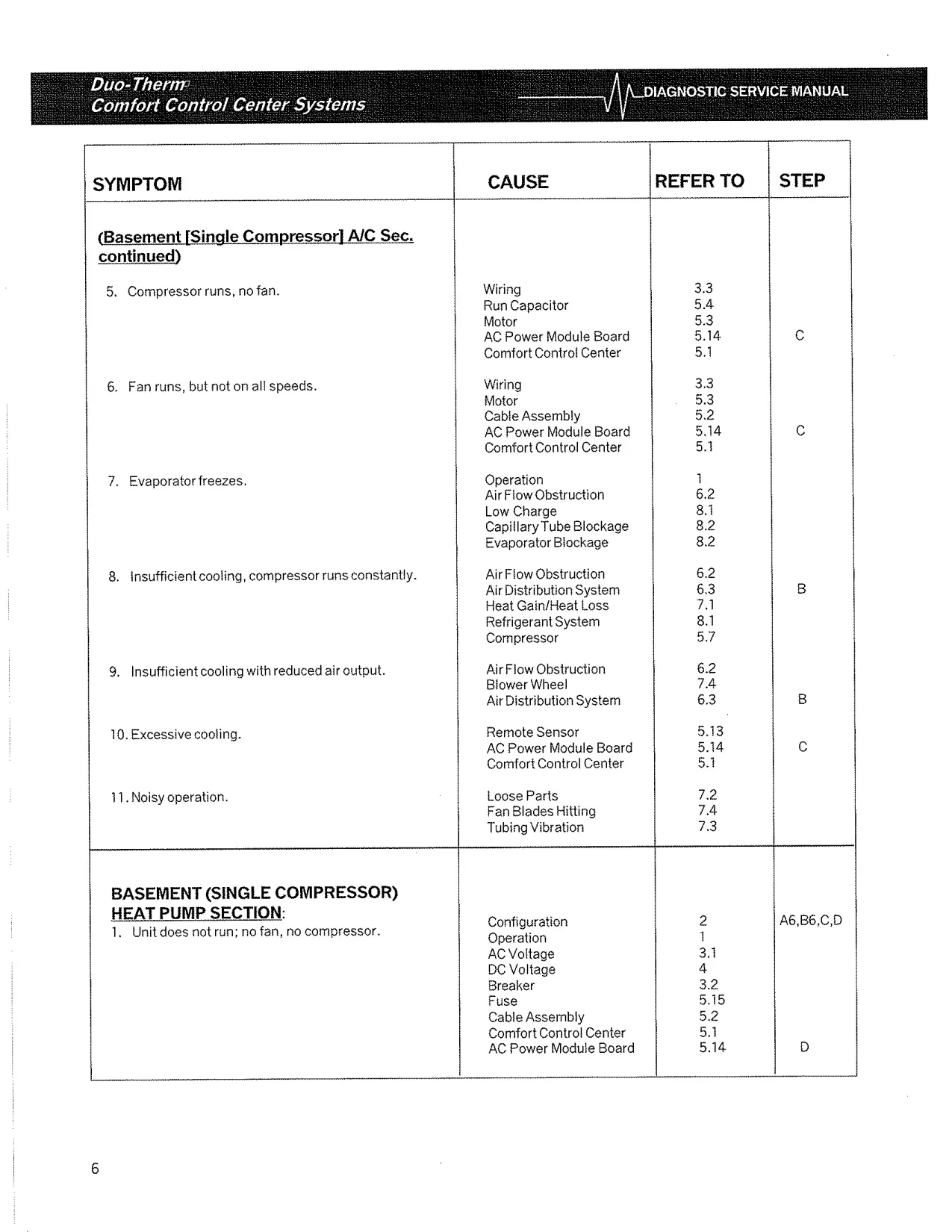


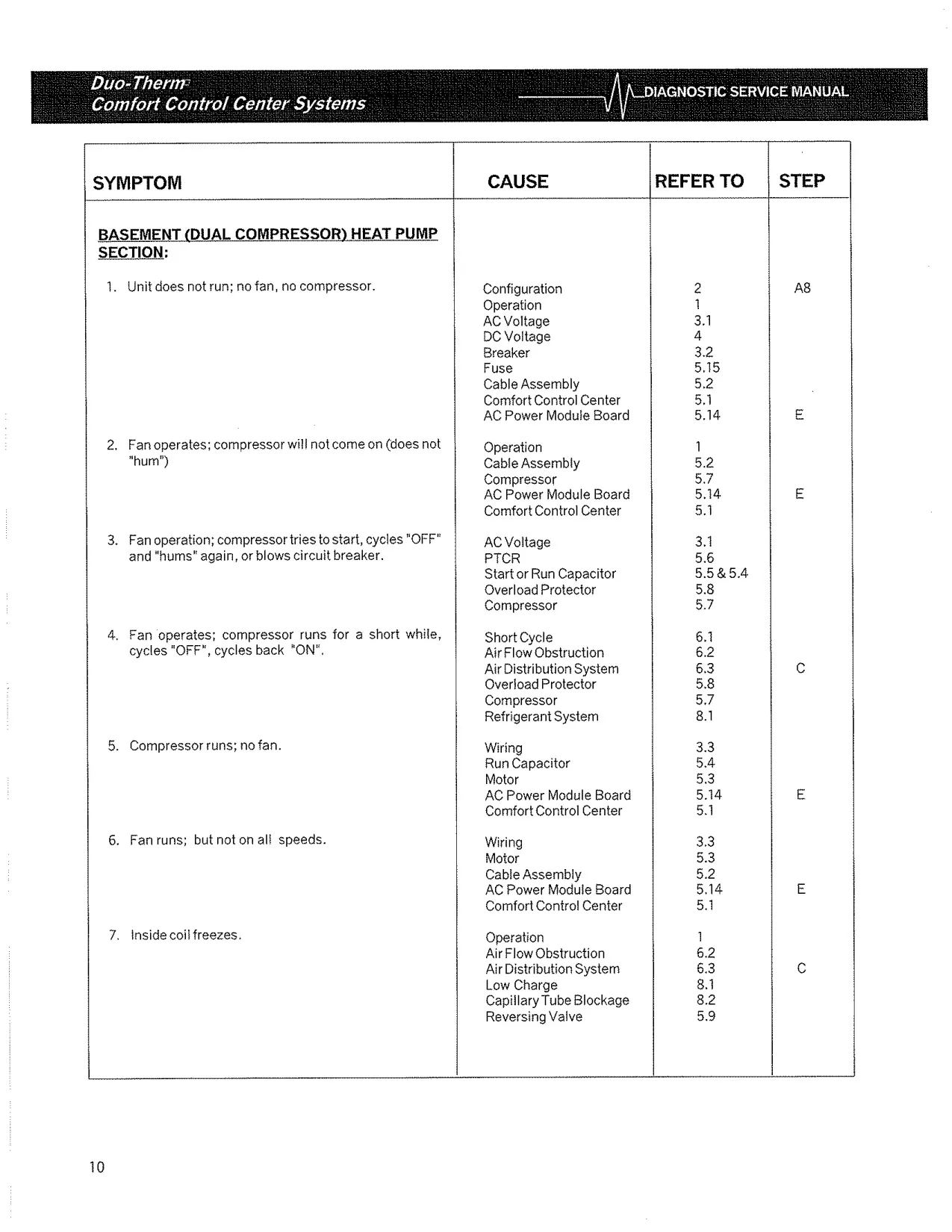


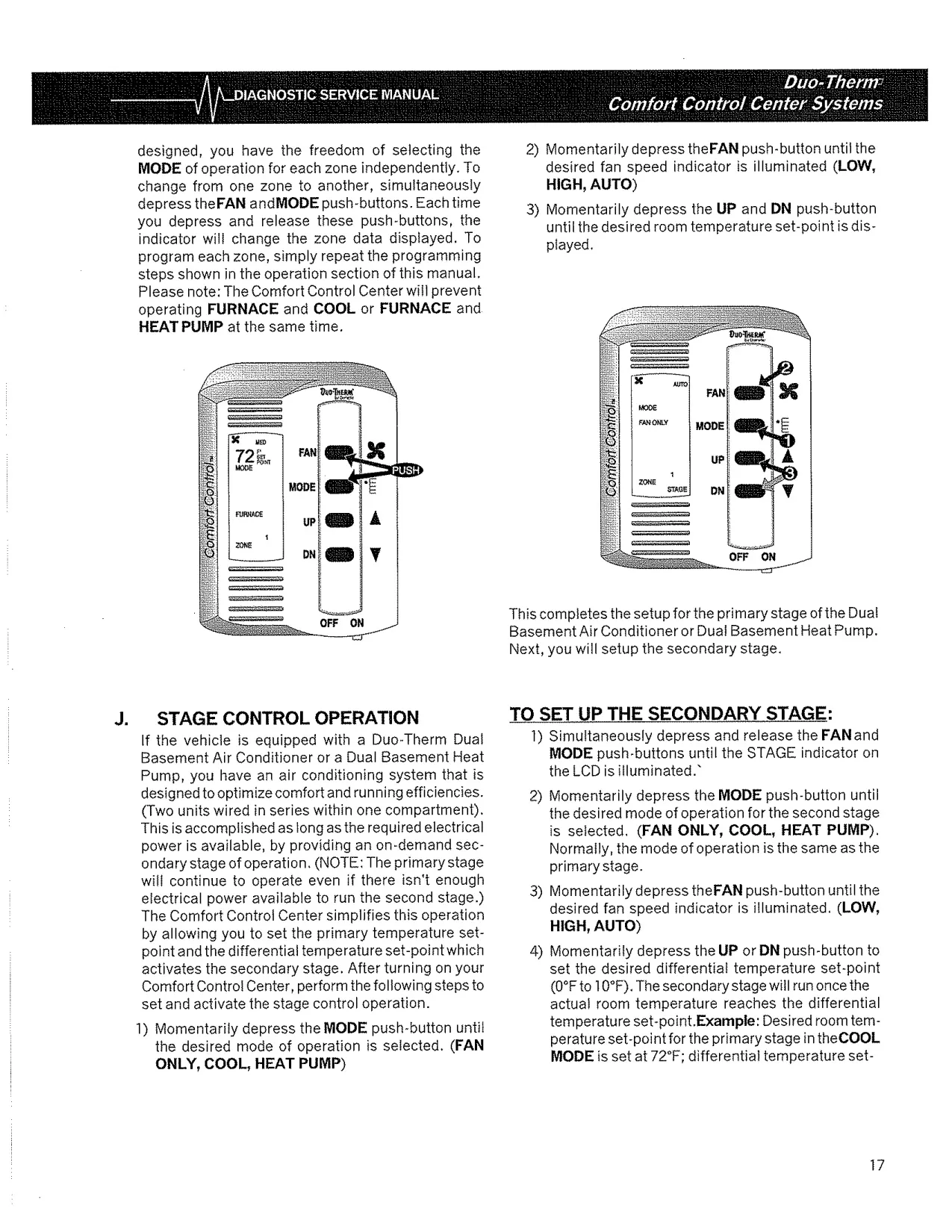
















Duo Therm RV Thermostat Instructions
Here we offer the Duo Therm RV Thermostat manual completely free and in English. We have cataloged this manual in the Thermostats section on Manualverse, and it has been rated by 1 users with an average rating of 5. If you have any specific questions about Duo Therm RV Thermostat, we suggest checking the Frequently Asked Questions (FAQs) section of this manual.
Product Images
Duo Therm RV Thermostat Specifications
| Feature | Specification |
|---|---|
| Product Name | Duo-Therm Comfort Control Center |
| Manufacturer | The Dometic Corporation |
| Part Number | 3106463.007 |
| Operating Instructions Form Number | 3106705.001 (6/95) |
| Display | Liquid Crystal Display (LCD) with incandescent backlight |
| Operating Modes | OFF, FAN ONLY, COOL, HEAT PUMP, FURNACE, HEAT STRIP |
| Fan Speeds | LOW, MEDIUM, HIGH, AUTO (LOW, HIGH, AUTO on heat pump and dual basement systems) |
| Temperature Set-Point Range | 40°F to 99°F |
| Temperature Scale | Fahrenheit or Celsius (set at installation) |
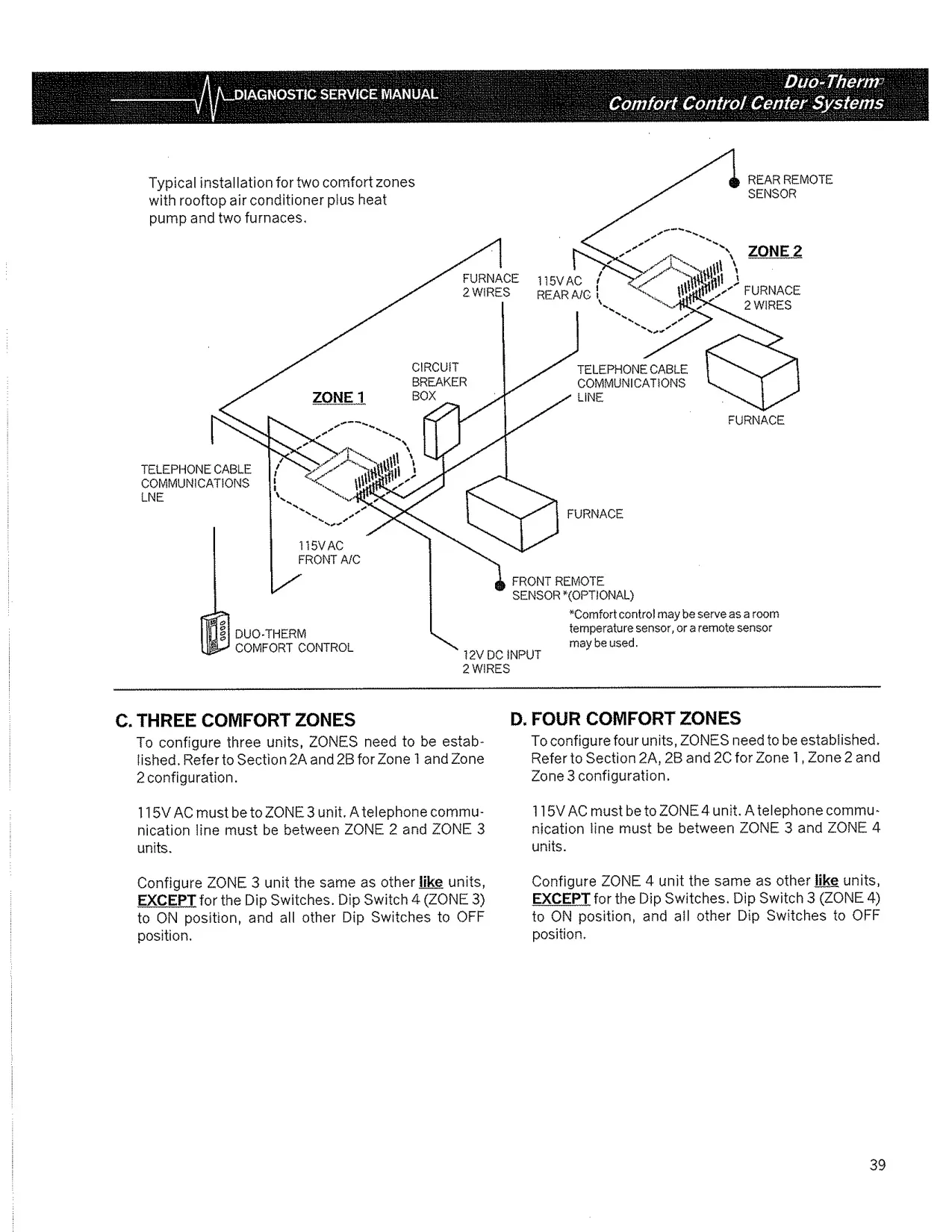
| Maximum Number of Zones | 4 |
| Stage Differential Set-Point Range | 0°F to 10°F |
| Compressor Time Delay | Approximately 2 minutes |
| Fan Start Delay (FAN ONLY Mode) | Approximately 5 seconds |
| Factory Reset Set-Points | 72°F cooling / 68°F heating |
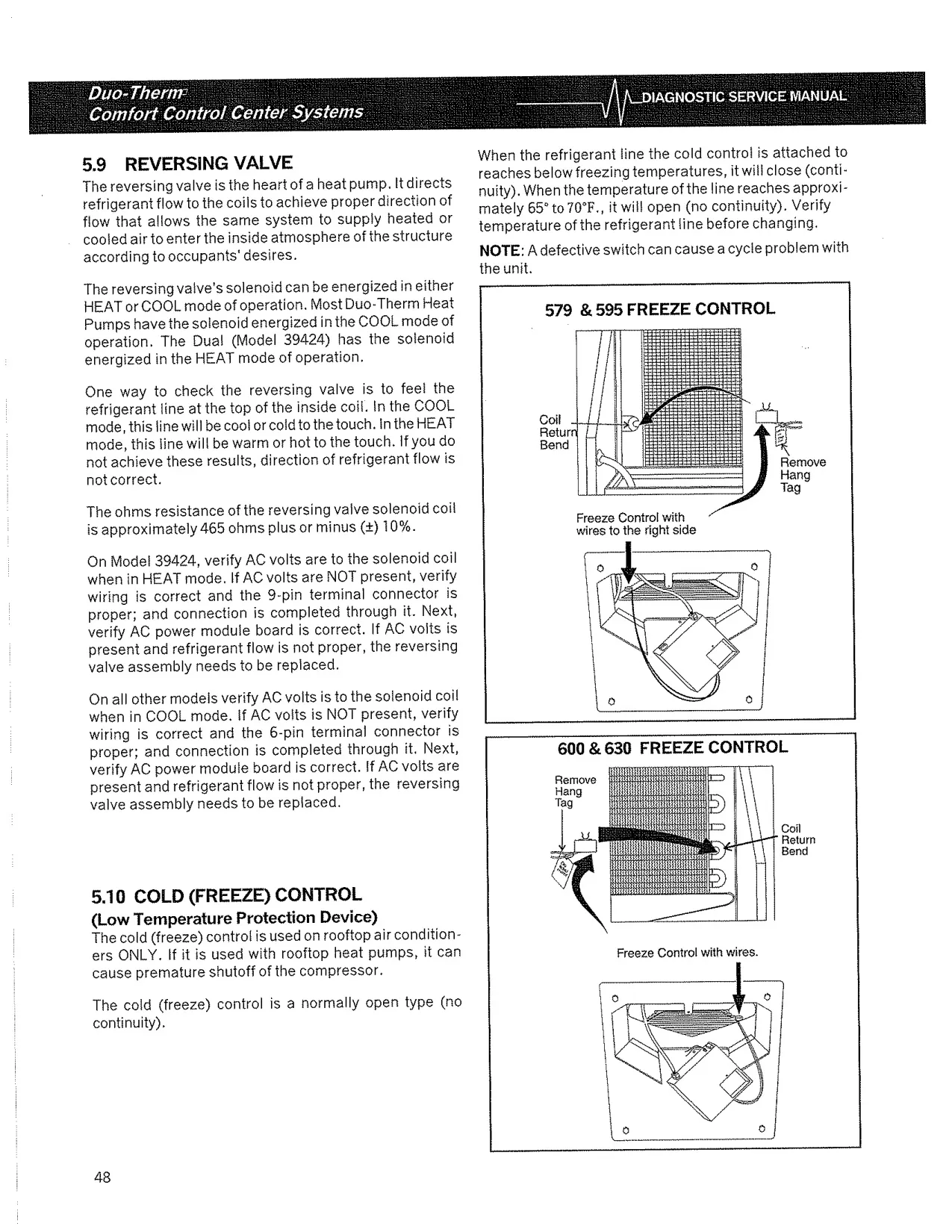
| Auxiliary Heat Switchover | Furnace engaged below 24°F outside; heat pump resumes above 34°F |
| Defrost Cycle Activation Range | Outside ambient below 42°F and above 24°F |
| Defrost Timing | 40 minutes heat pump operation, 4-1/2 minutes reversed flow, 30-second delay |
| Control DC Supply Voltage | 10 to 30 VDC (12 VDC nominal) |
| Appliance AC Supply | 115 VAC, 60 Hz (operating range 103 V to 126.5 V) |
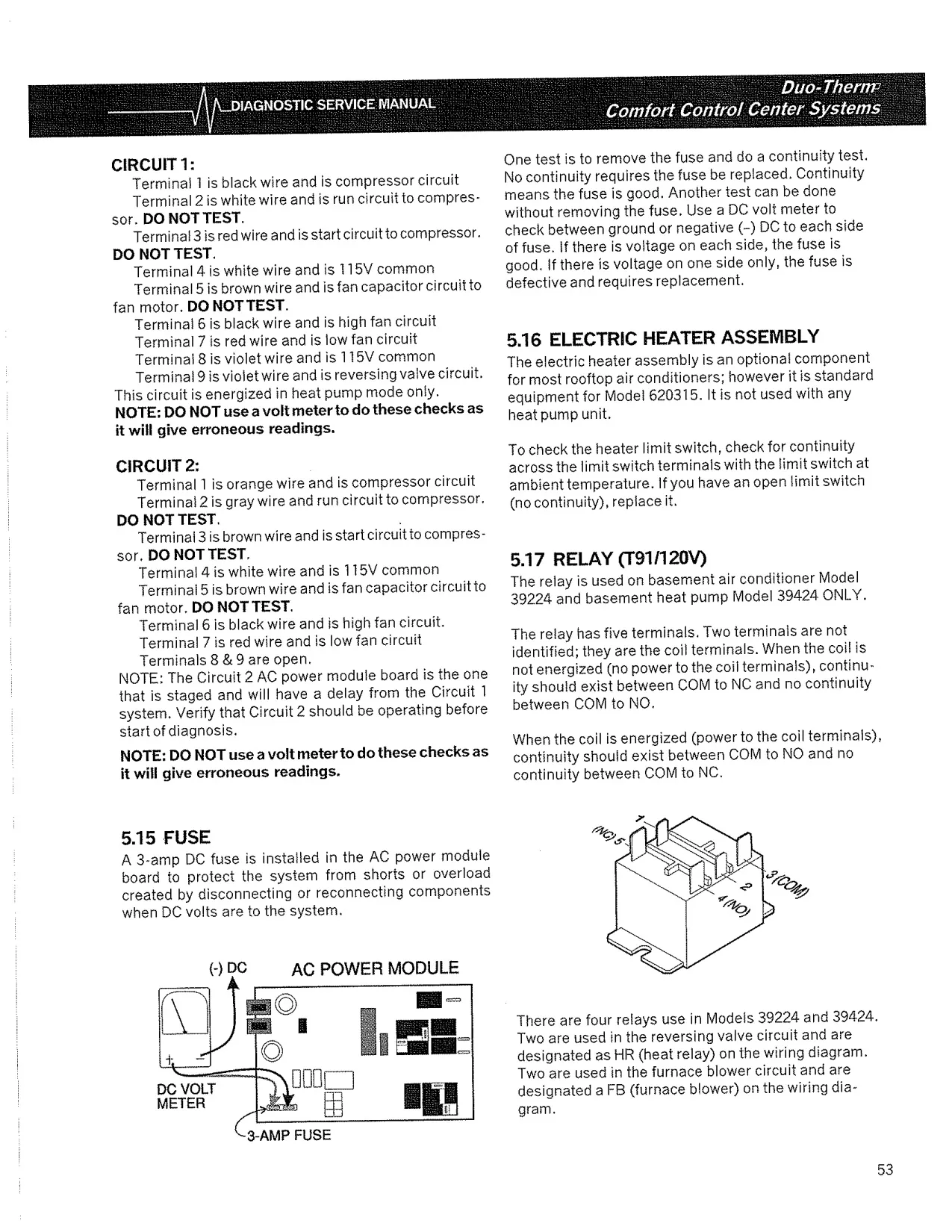
| AC Power Module Fuse | 3-amp DC fuse |
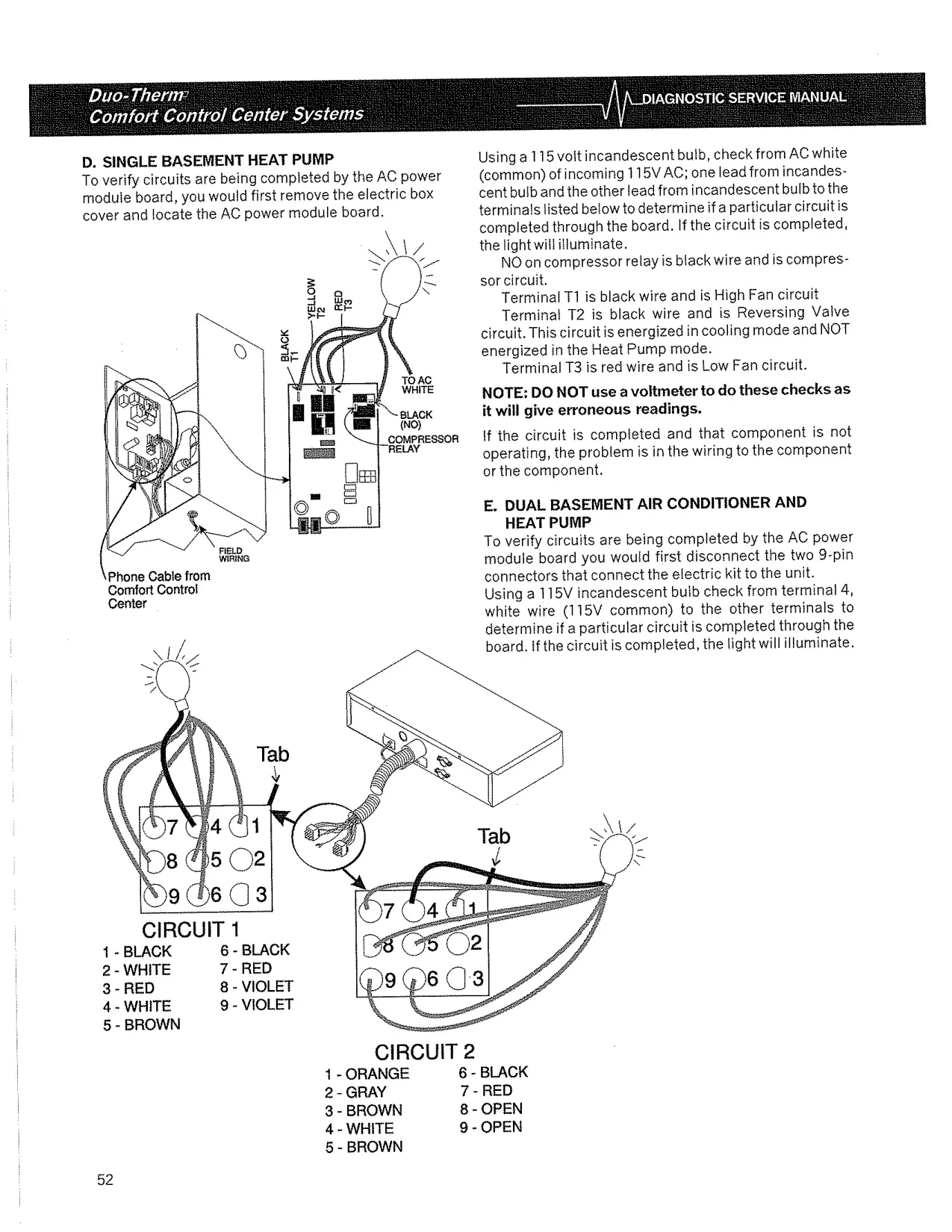
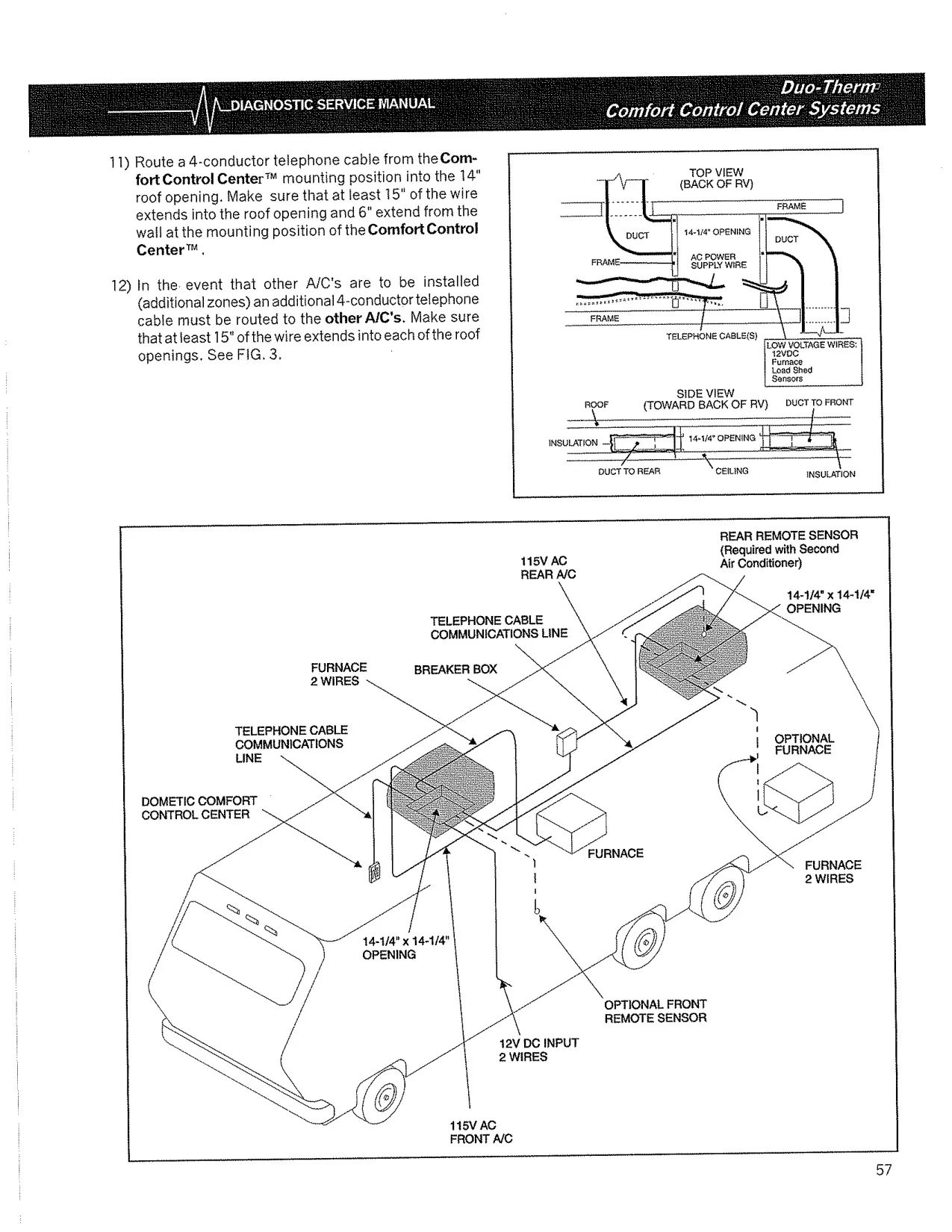
| Communication Cable | 26 gauge stranded copper, 4-conductor flat telephone cable (yellow, green, red, black) |
| Cable Connector | 4-position RJ-11 modular plug |
| Dedicated 12 VDC Supply Wire | 18 to 22 AWG |
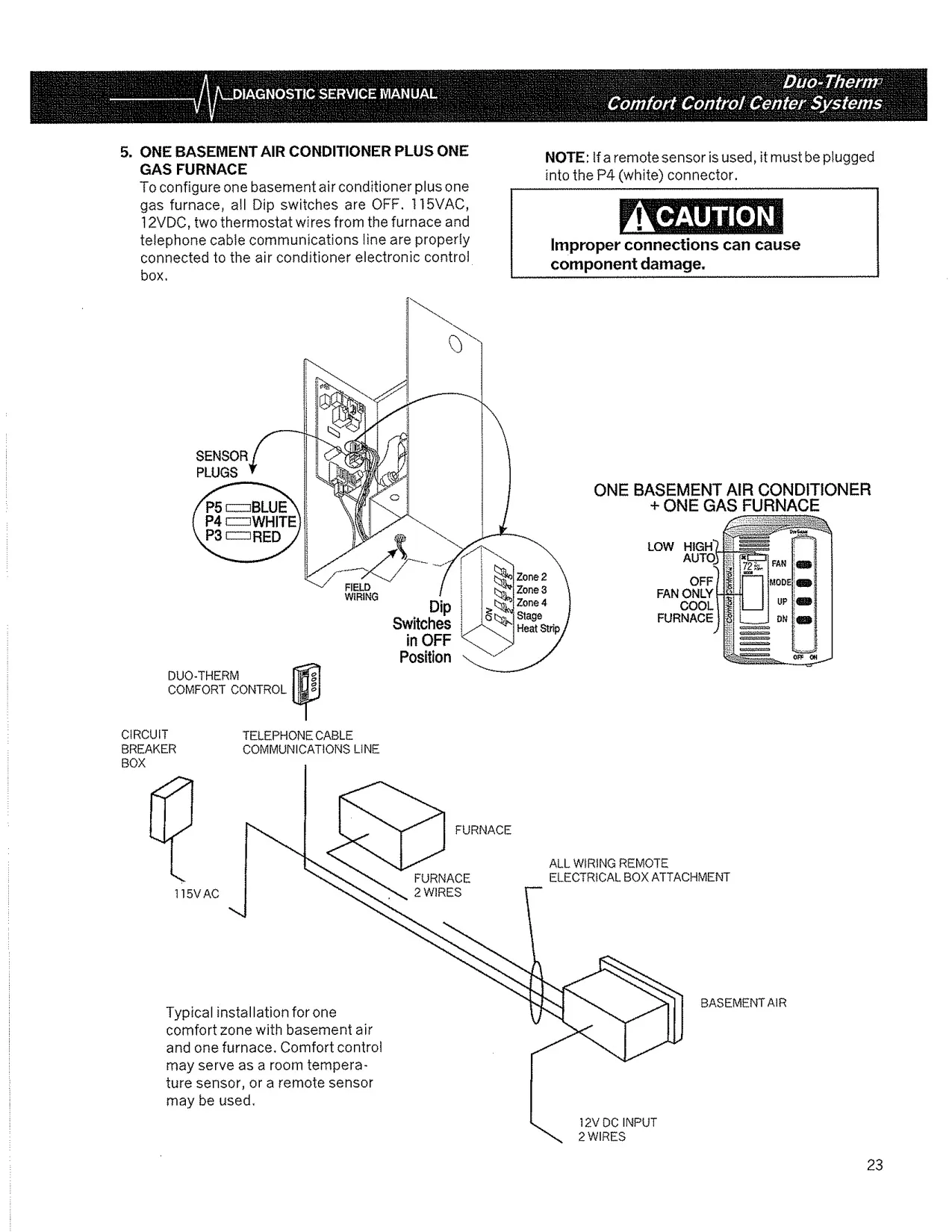
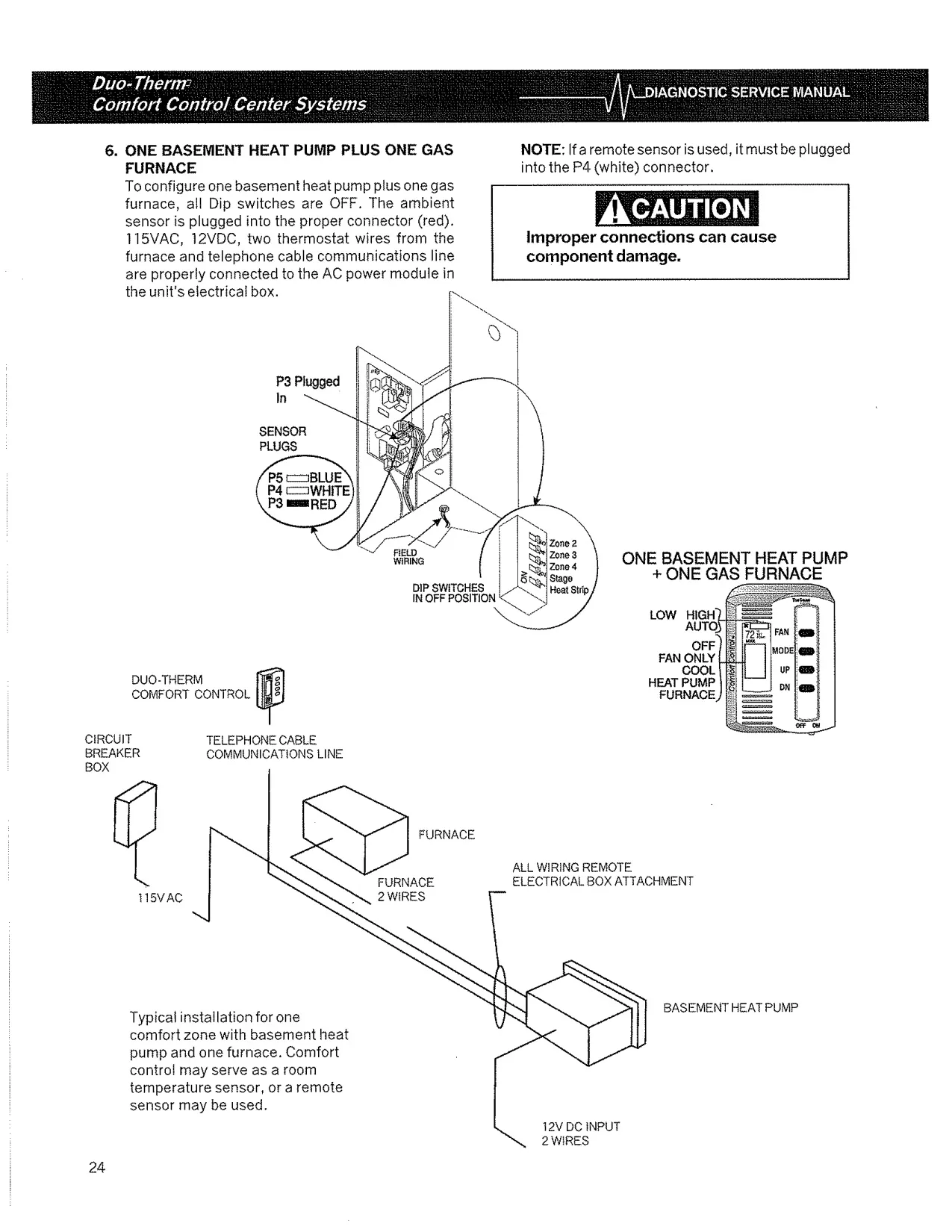
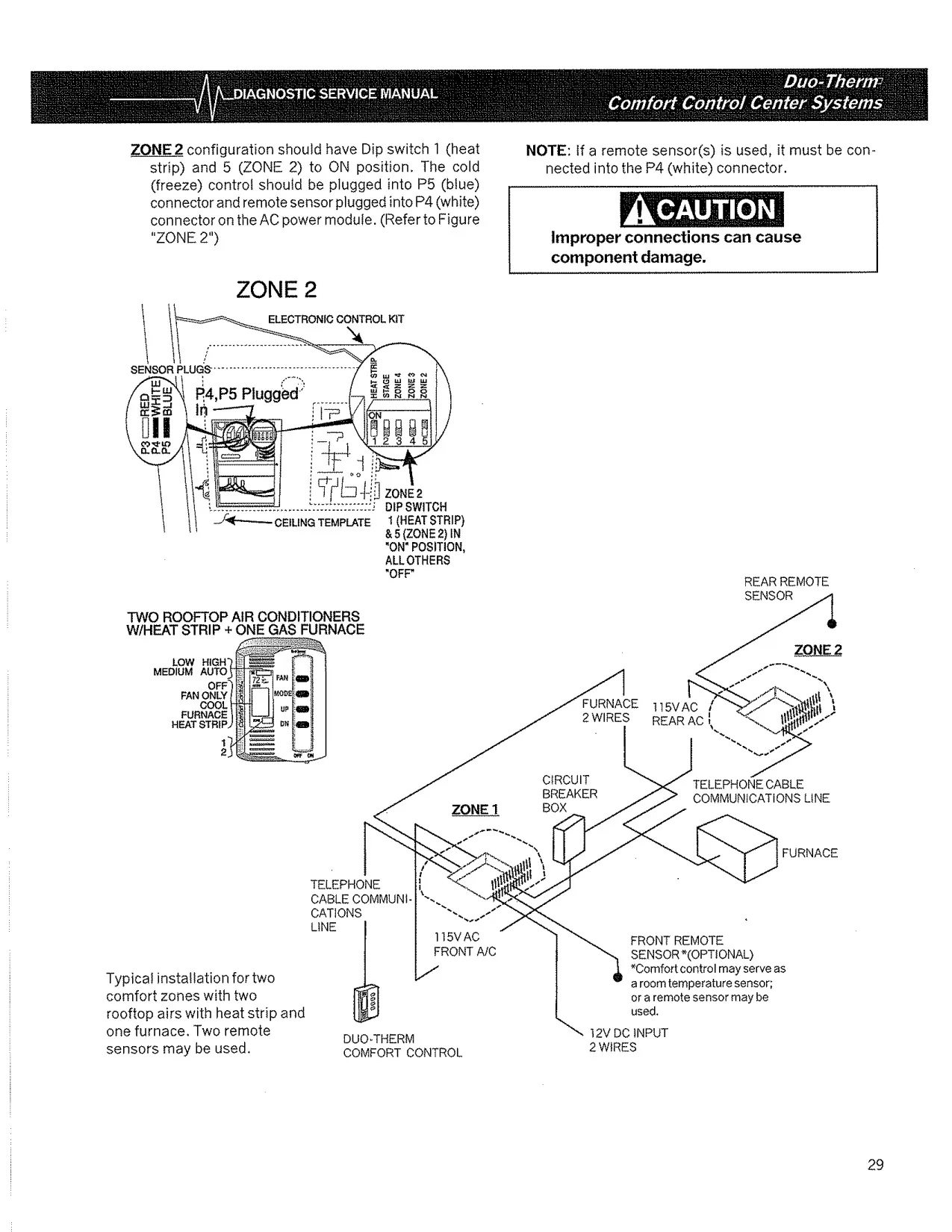
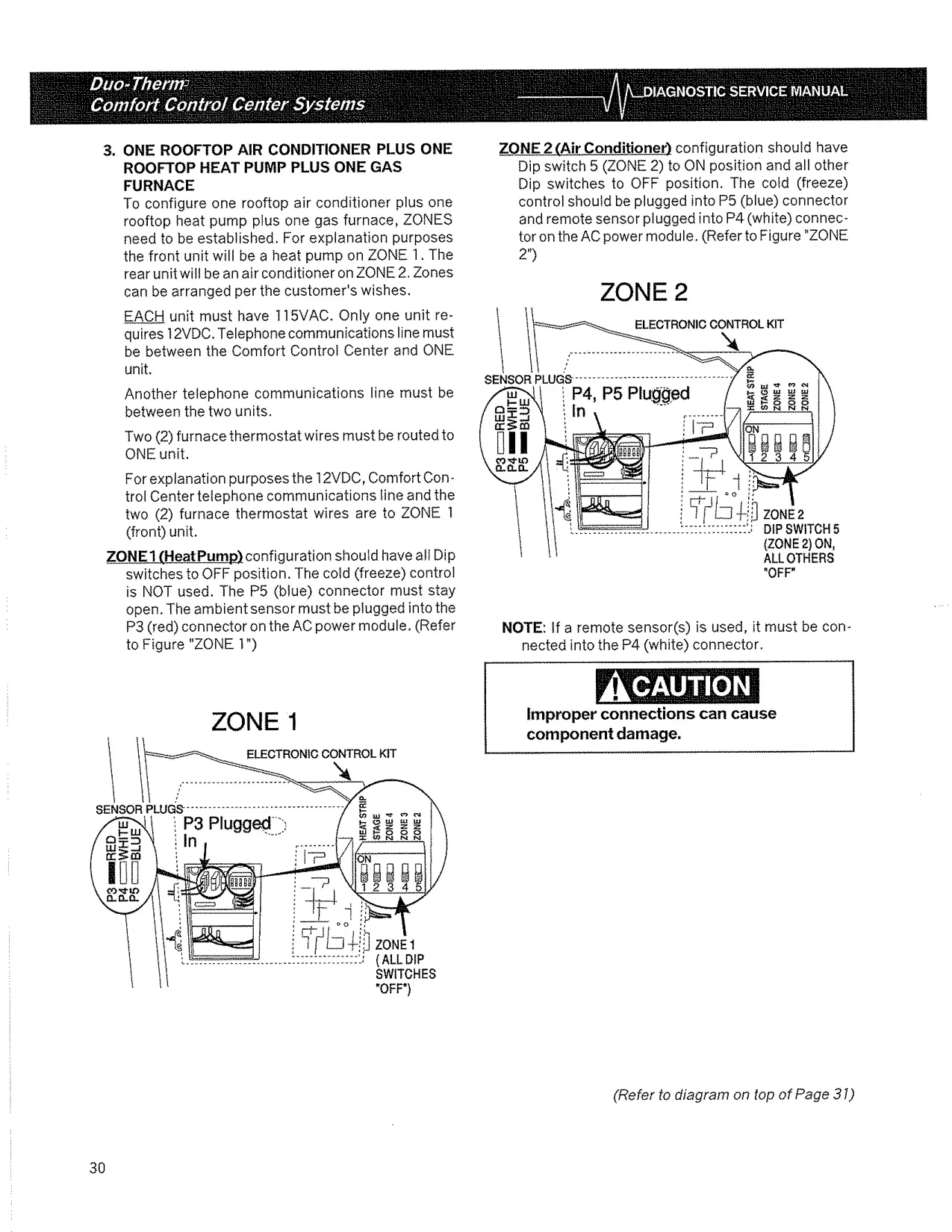
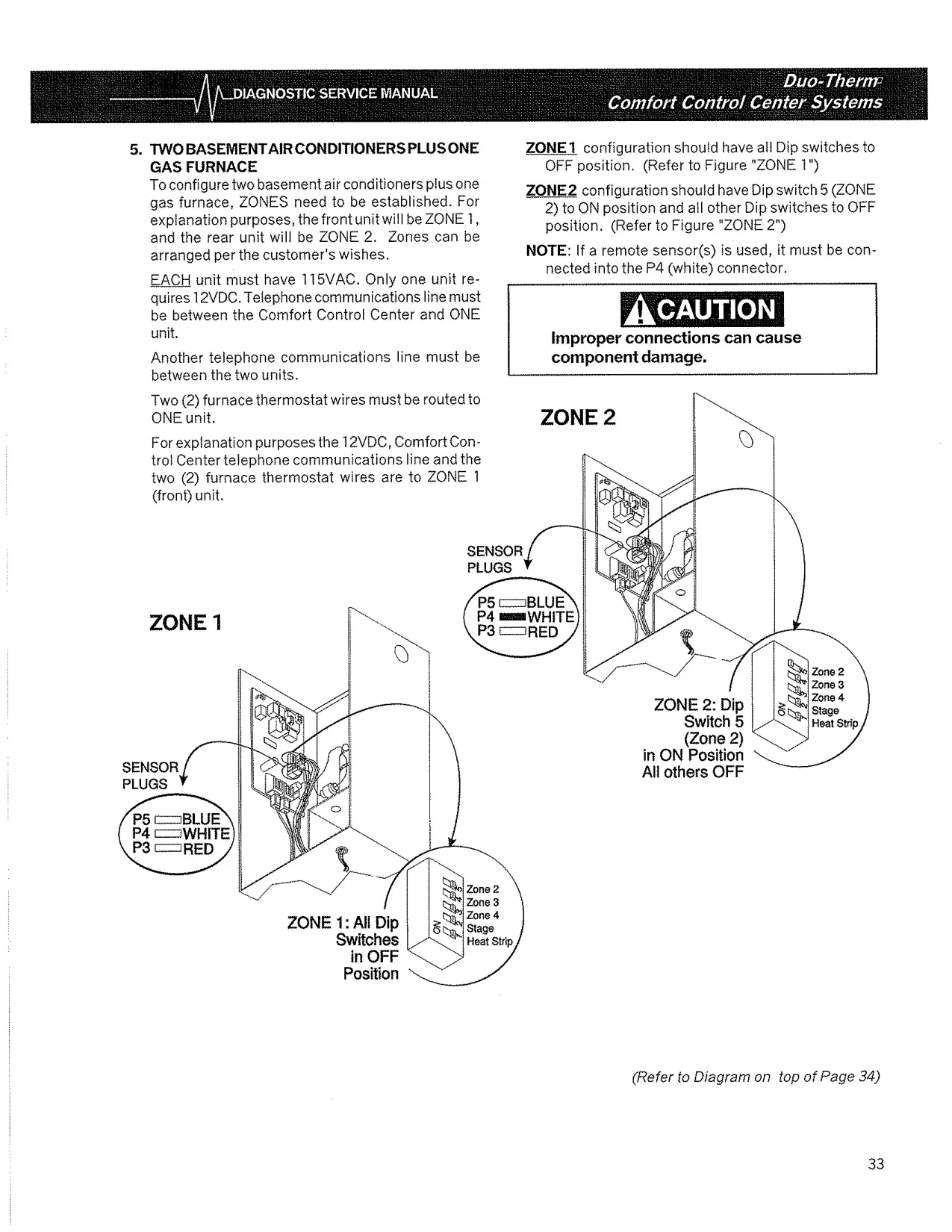
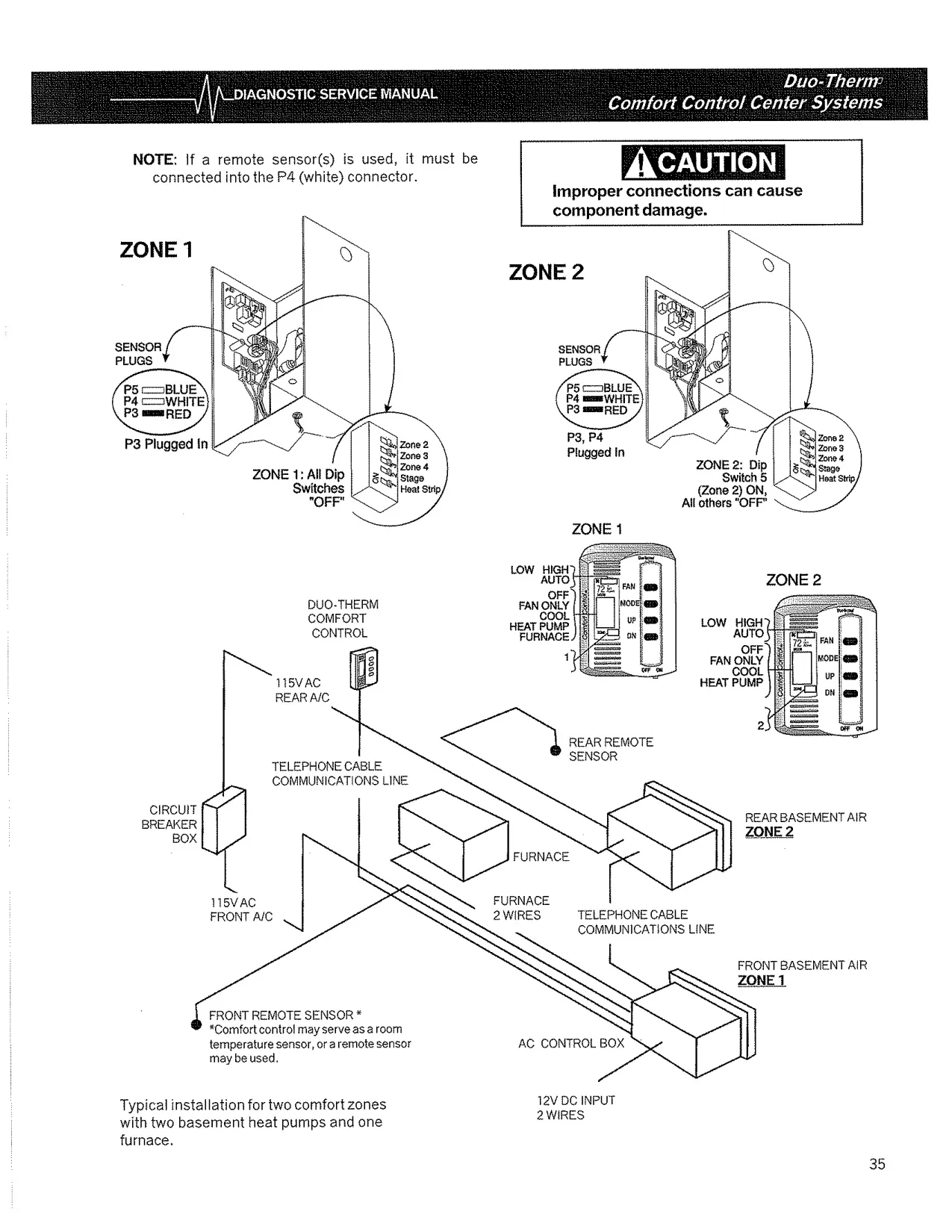
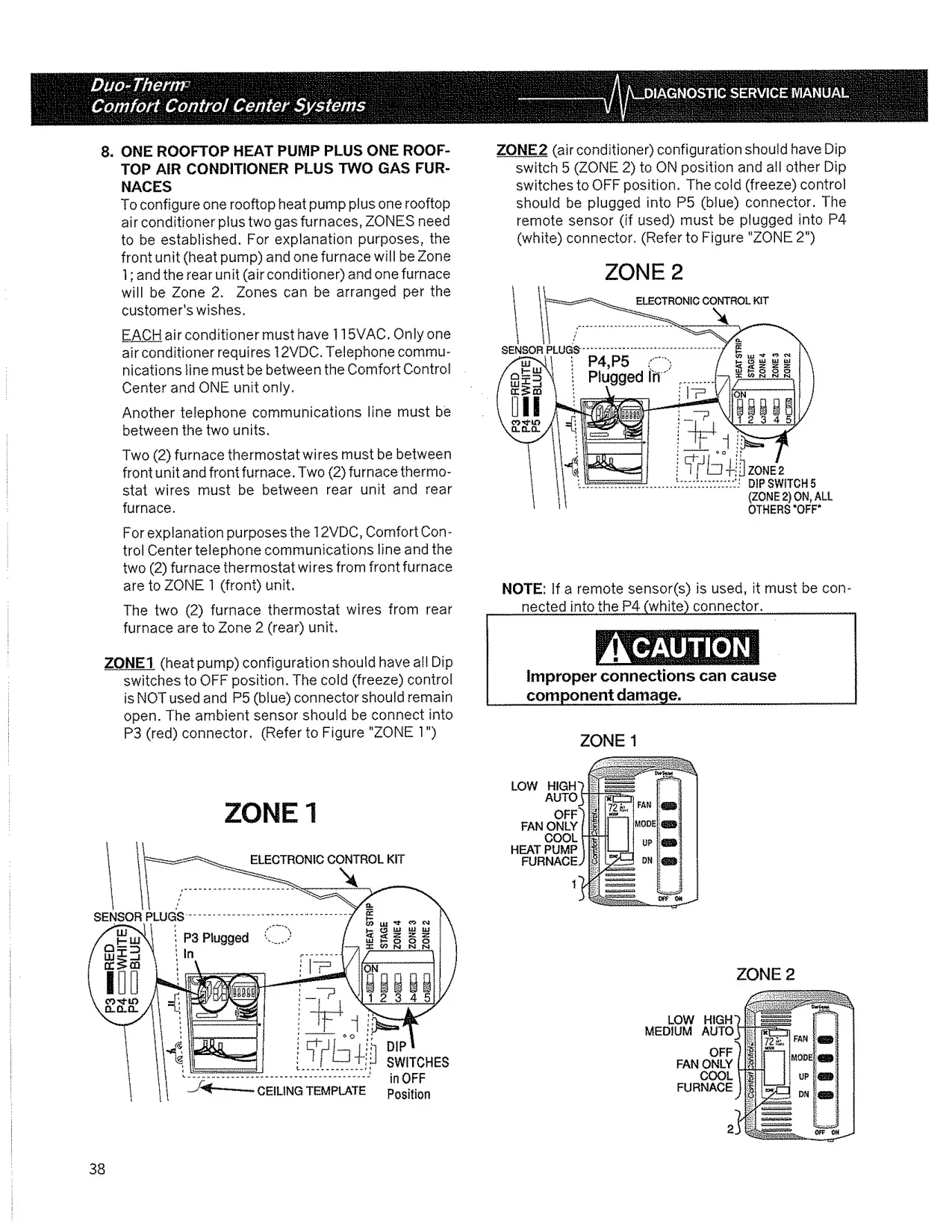
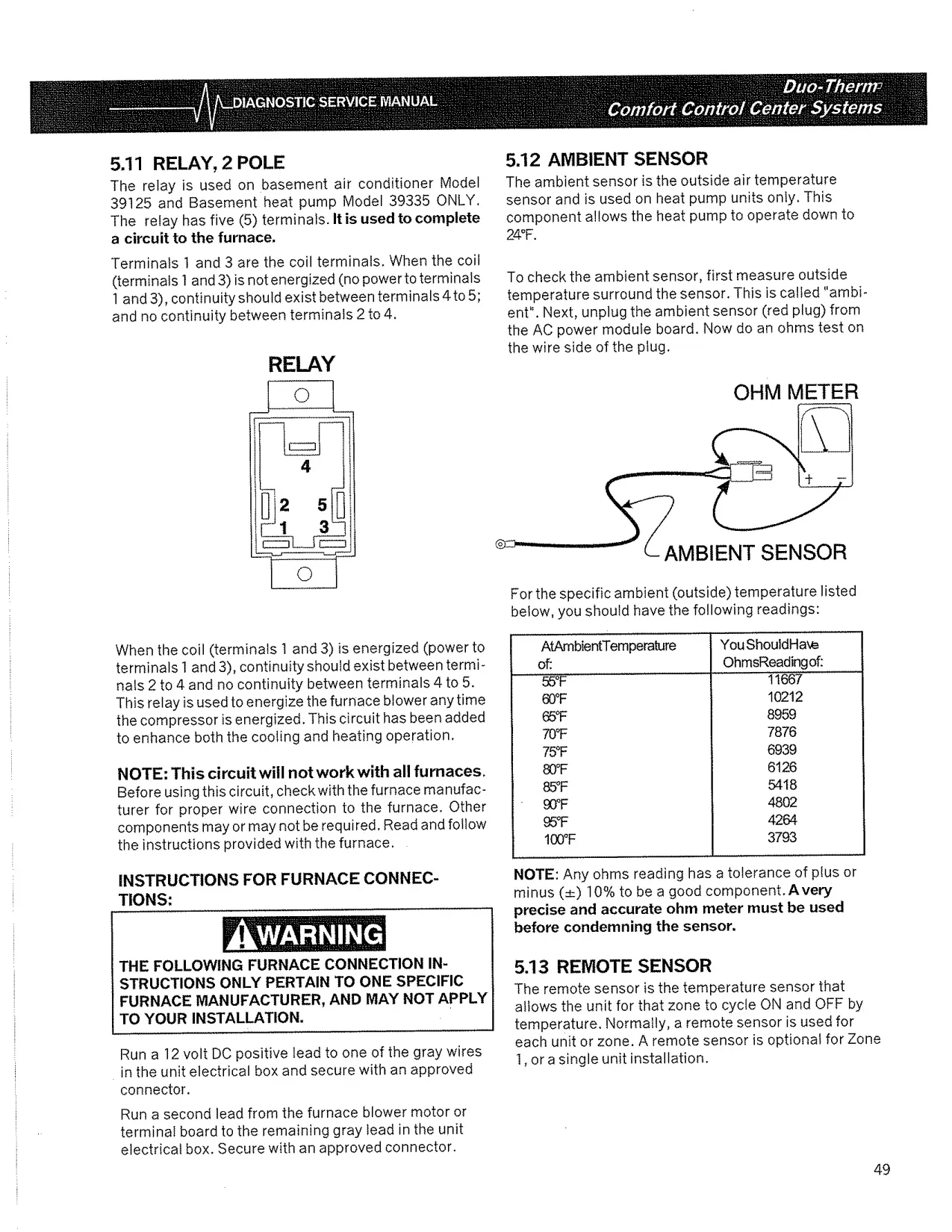
| Sensor Plug Connectors | P3 red (ambient sensor), P4 white (remote sensor), P5 blue (cold/freeze control) |
| Dip Switch Functions | #1 Heat Strip, #2 Stage, #3 Zone 4, #4 Zone 3, #5 Zone 2 |
| Recommended Mounting Height | 54 in above the floor |
| Sensor Resistance (Ambient and Remote) | 11,667 Ω at 55°F to 3,793 Ω at 100°F (±10%) |
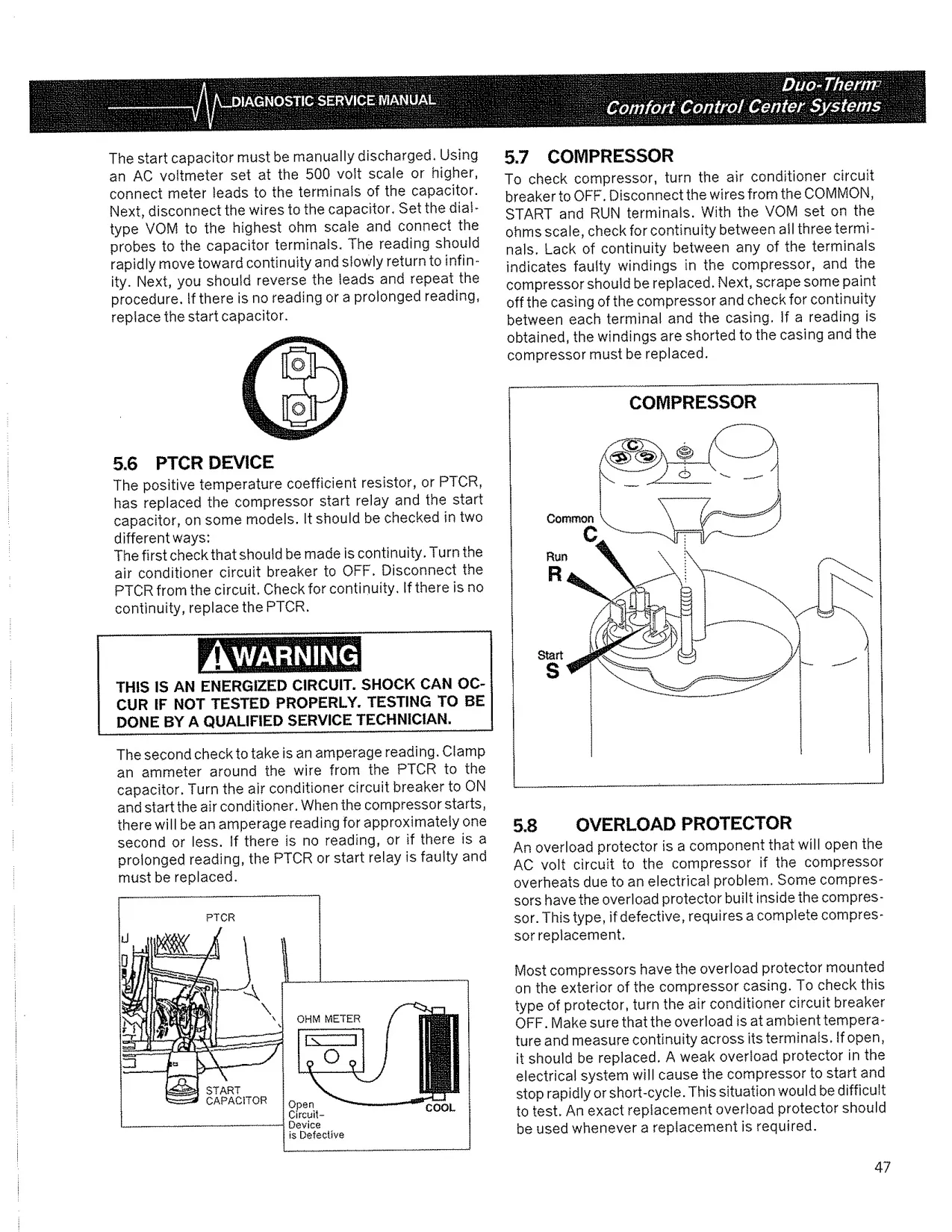
| Reversing Valve Solenoid Resistance | Approximately 465 Ω ±10% |
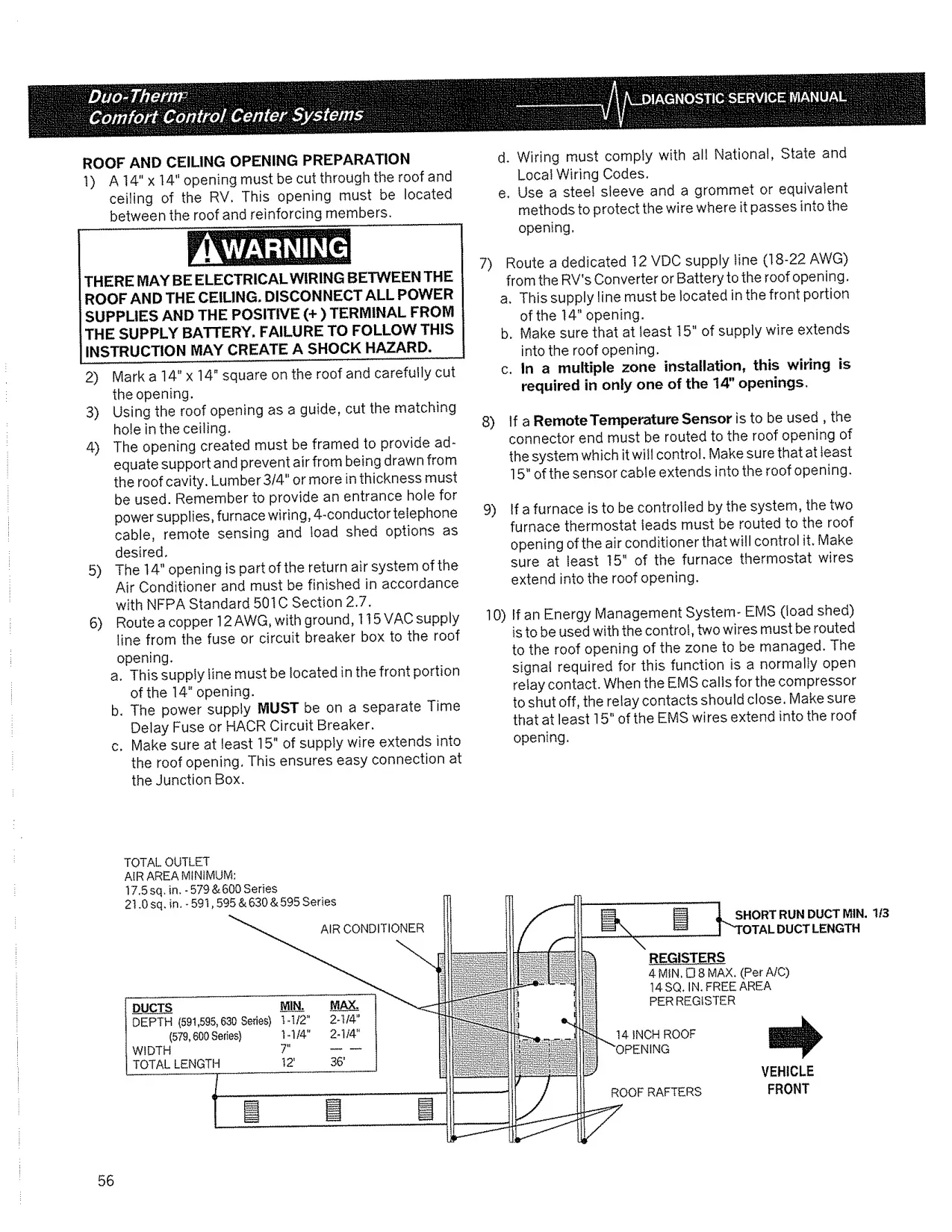
| Rooftop Unit Circuit Protection | 20 amp time delay fuse or 20 amp HACR breaker |
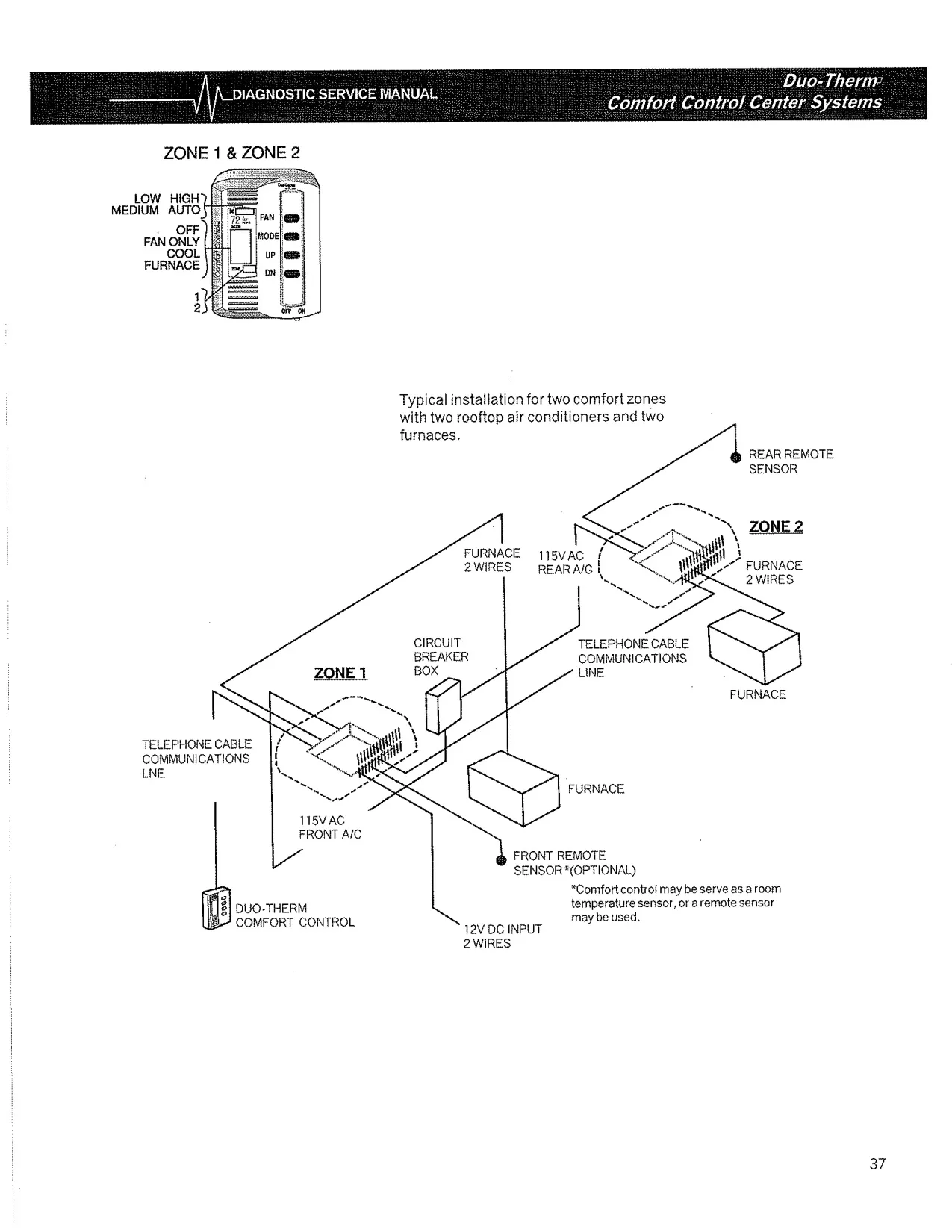
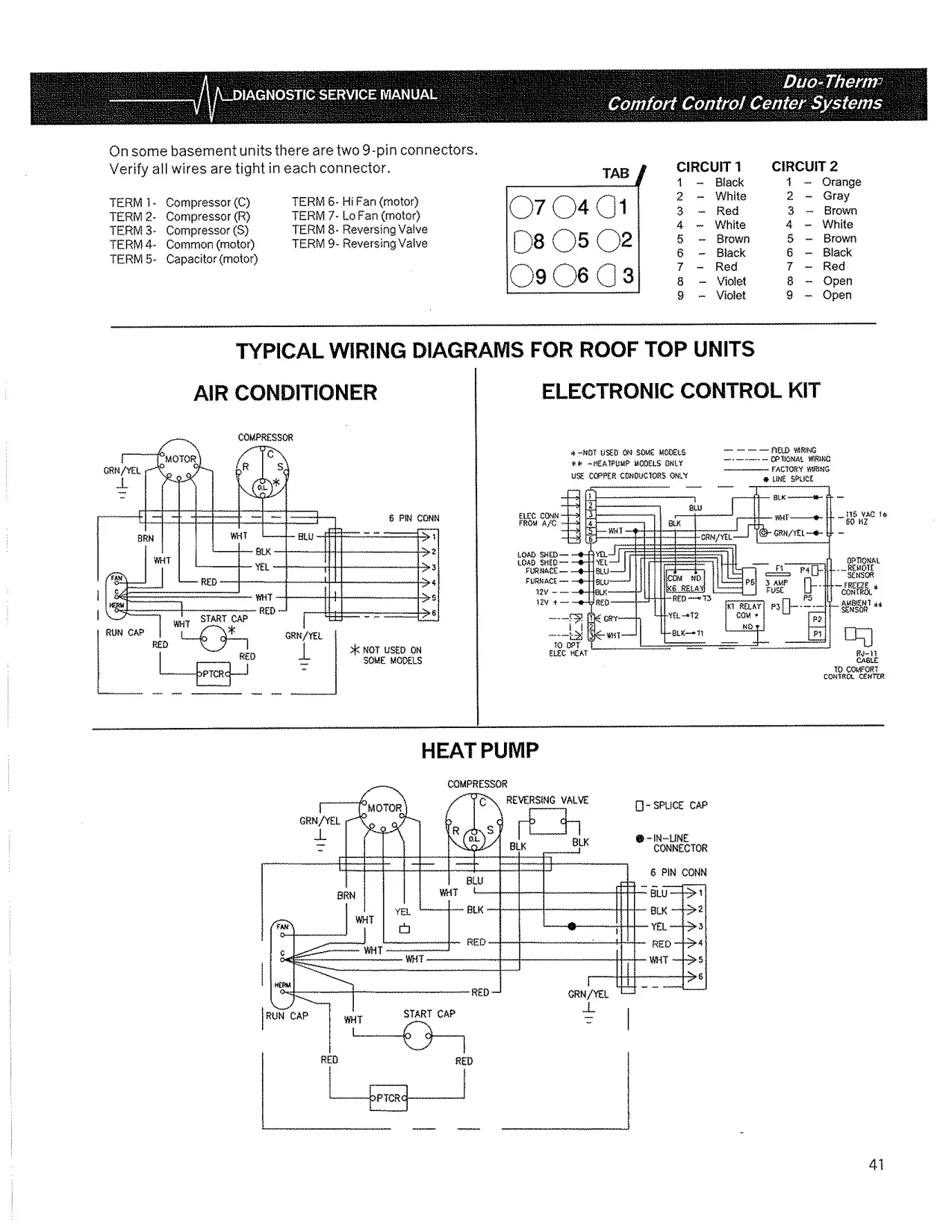
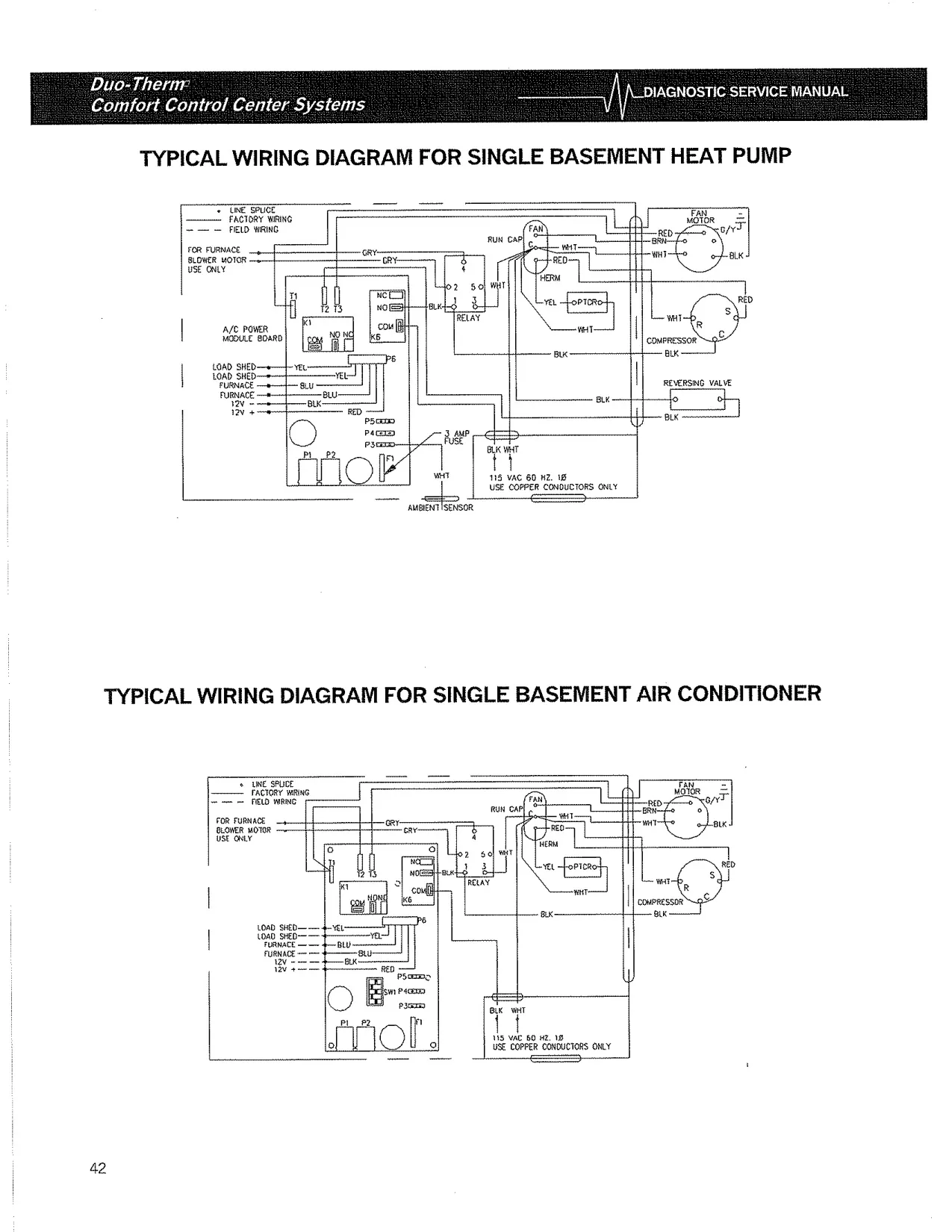
| Compatible Appliances | Duo-Therm rooftop and basement air conditioners, heat pumps, dual basement units, gas furnaces |
Duo Therm RV Thermostat Details
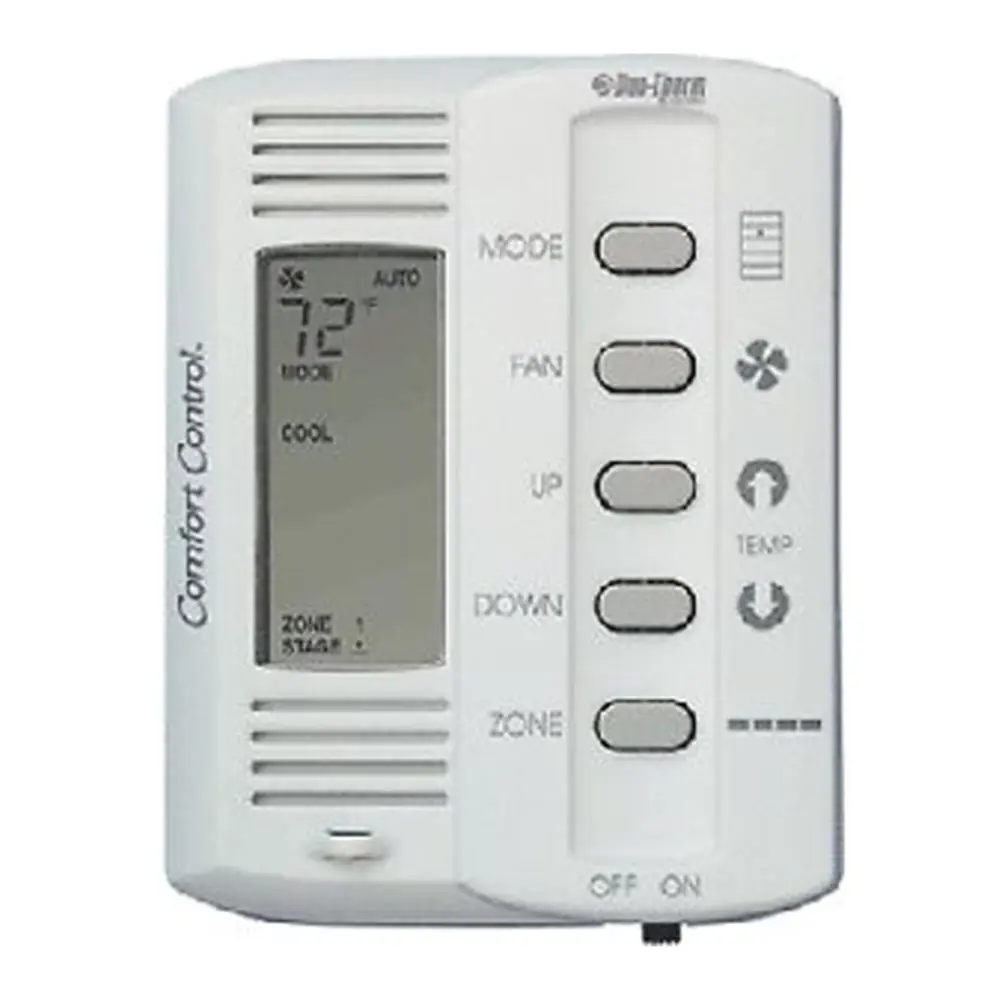
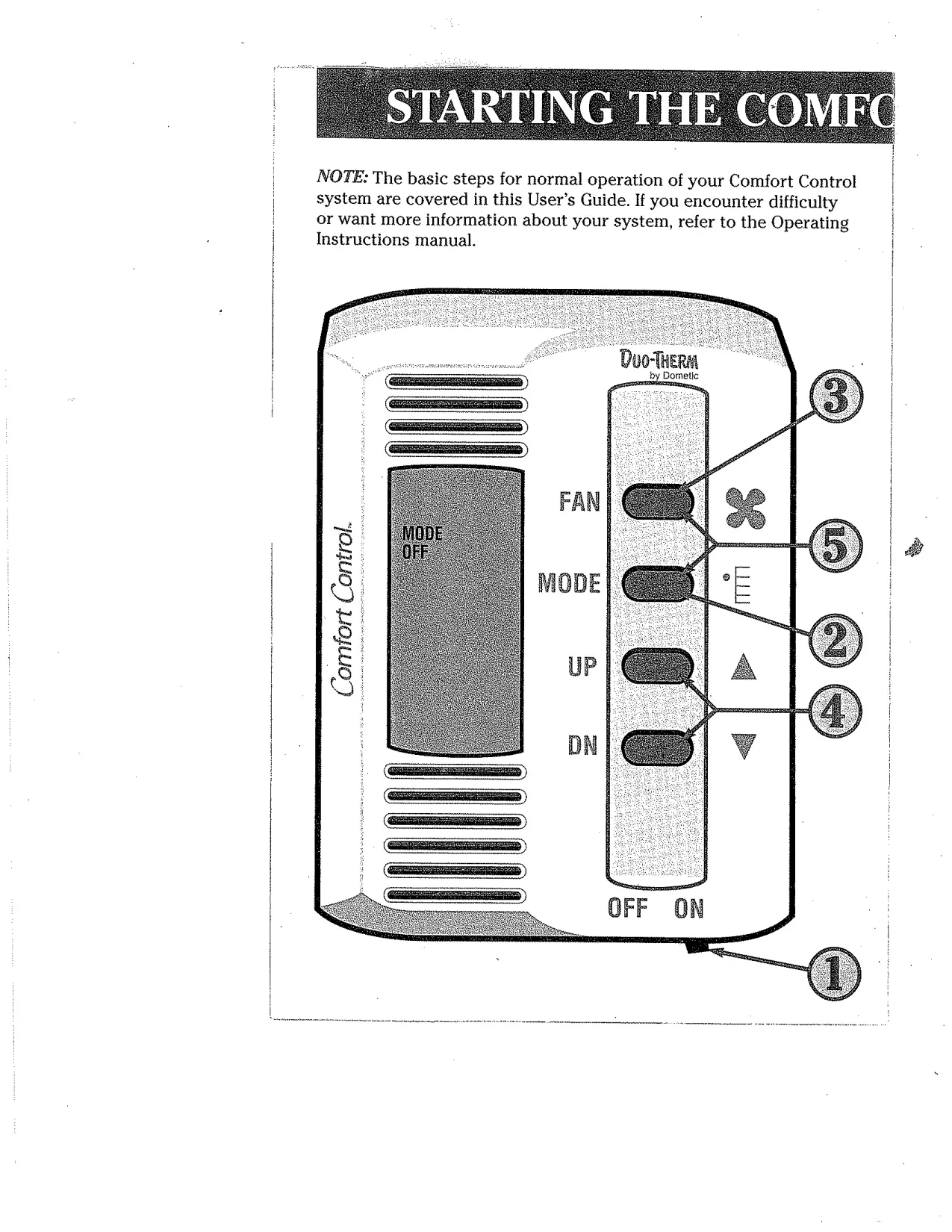
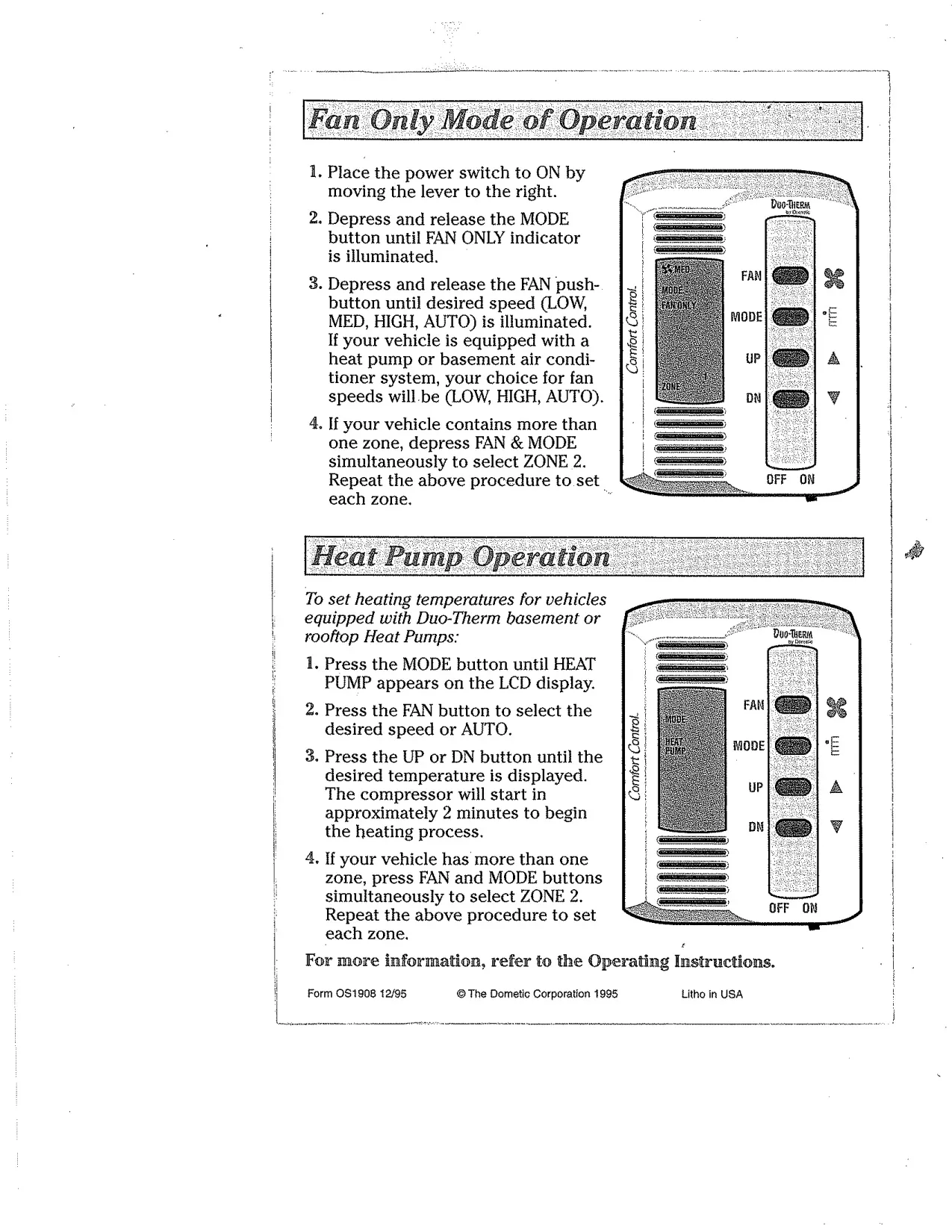
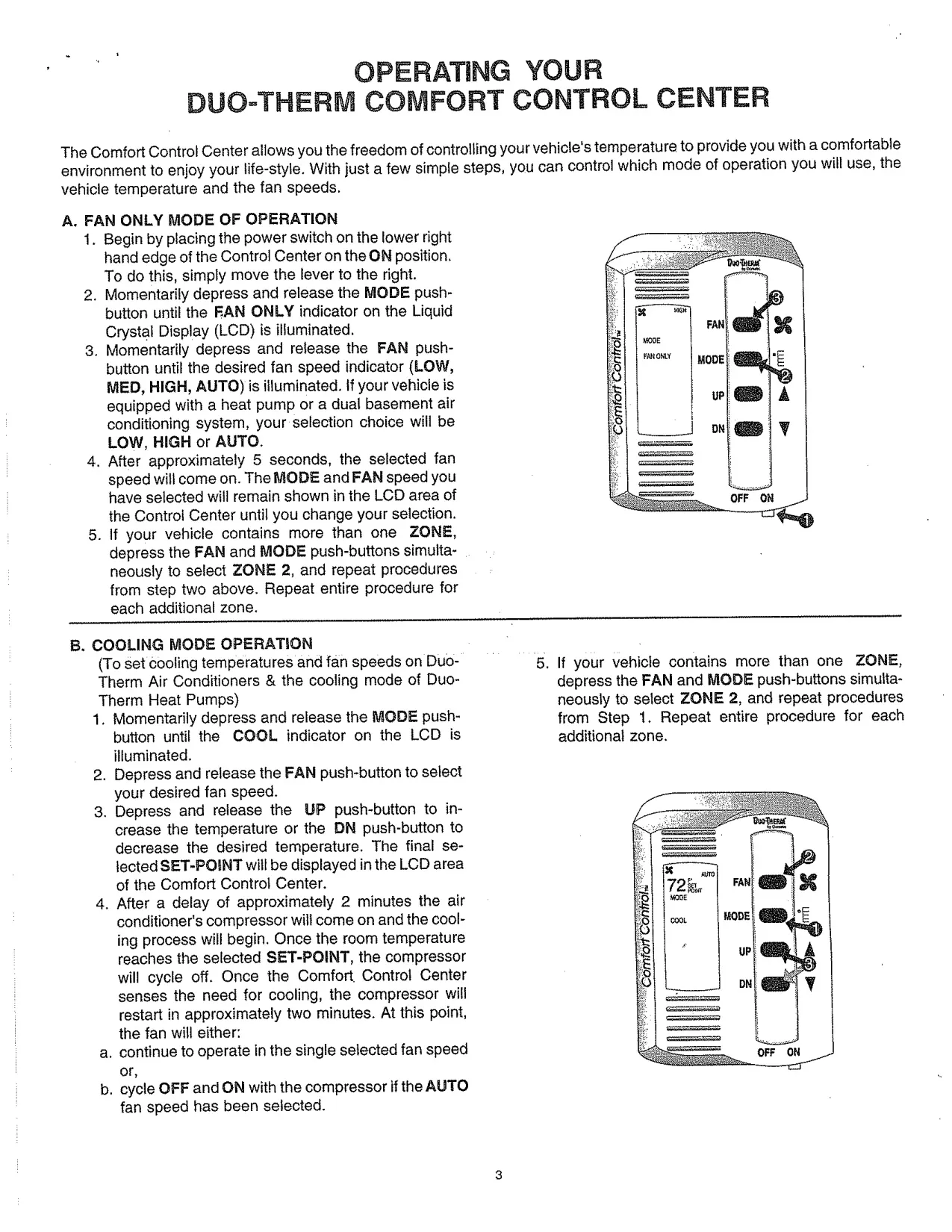
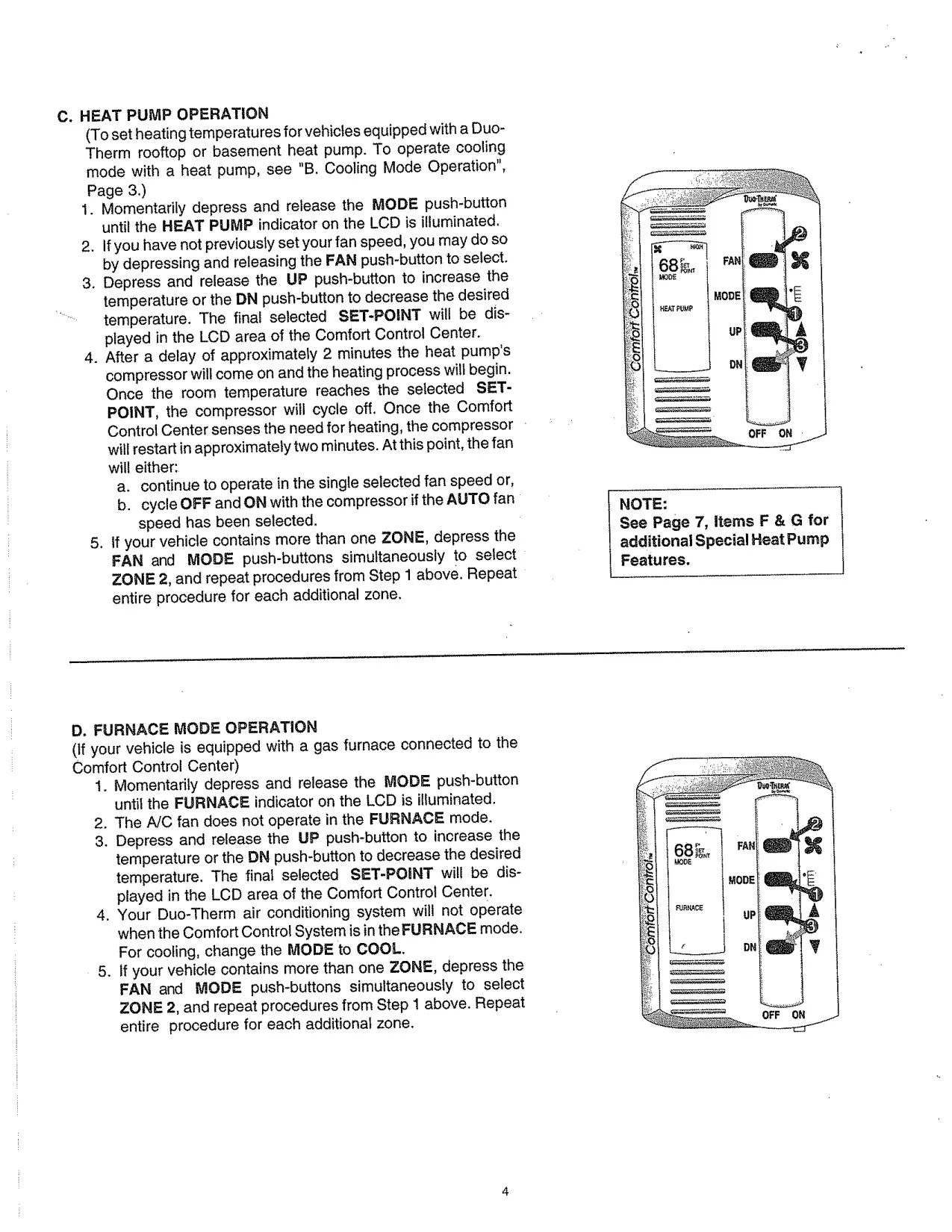
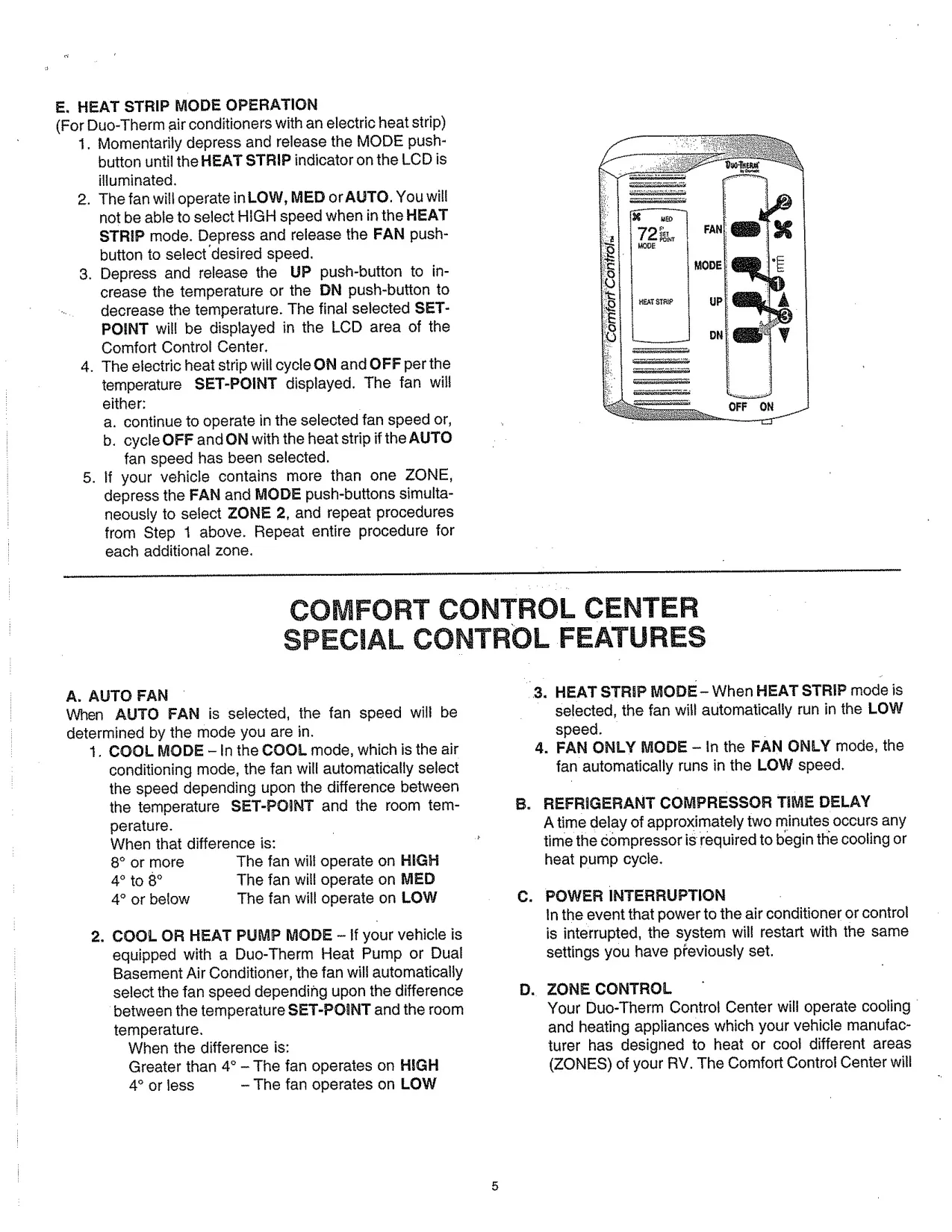
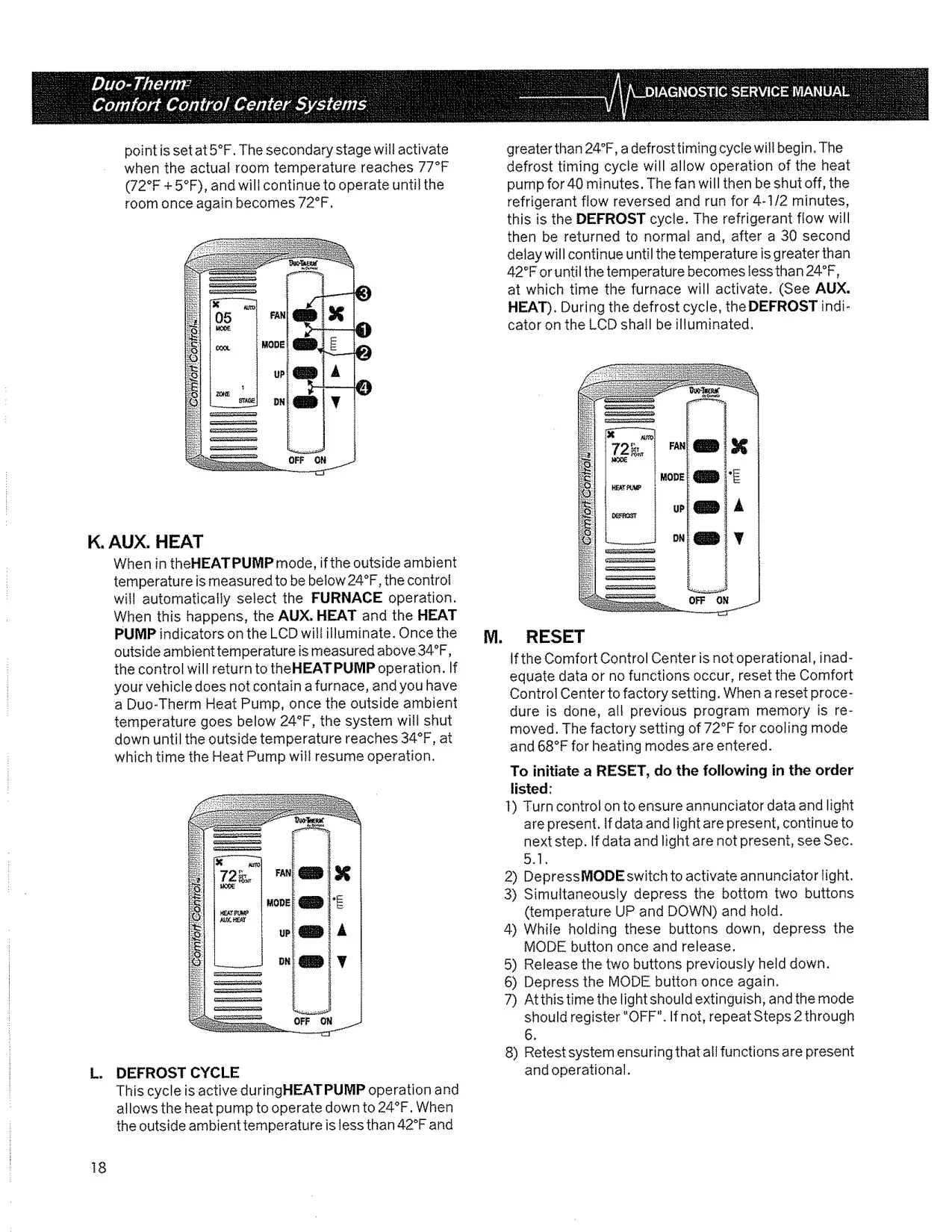
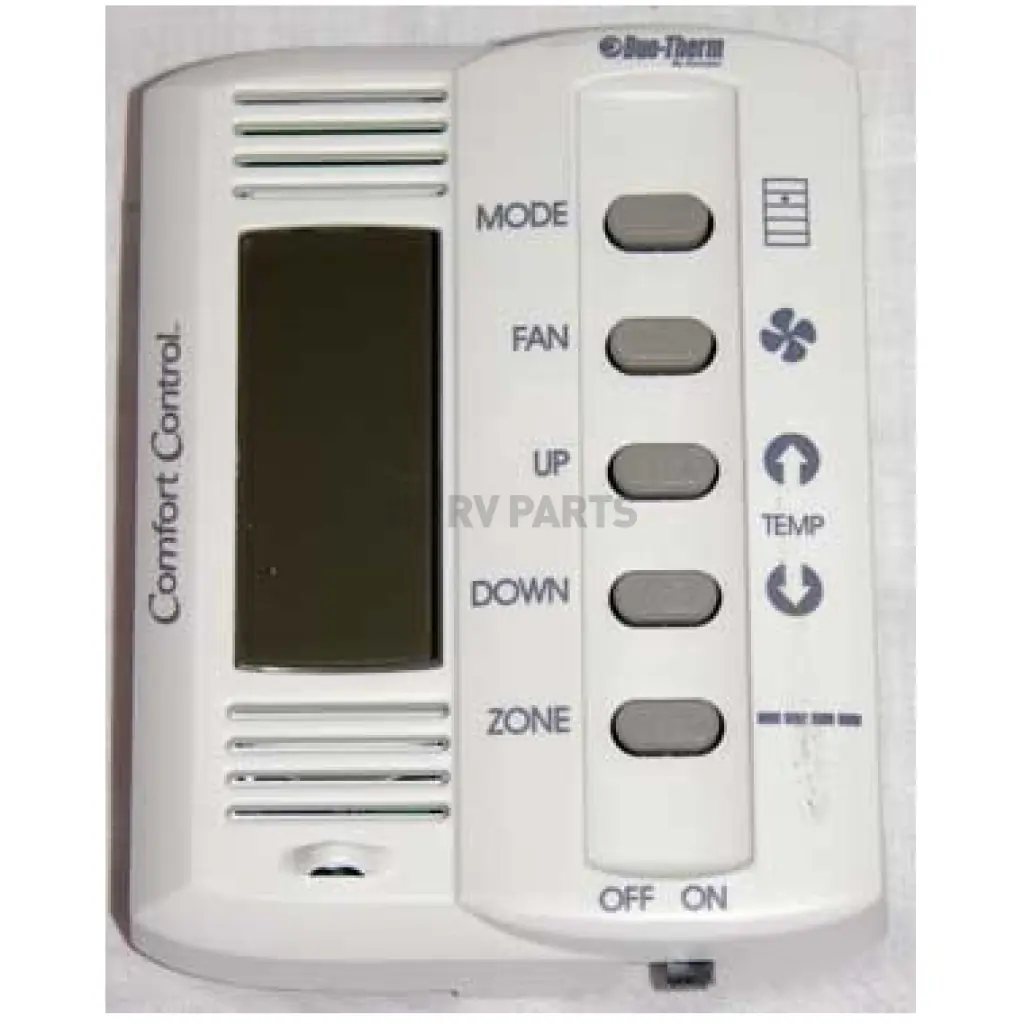
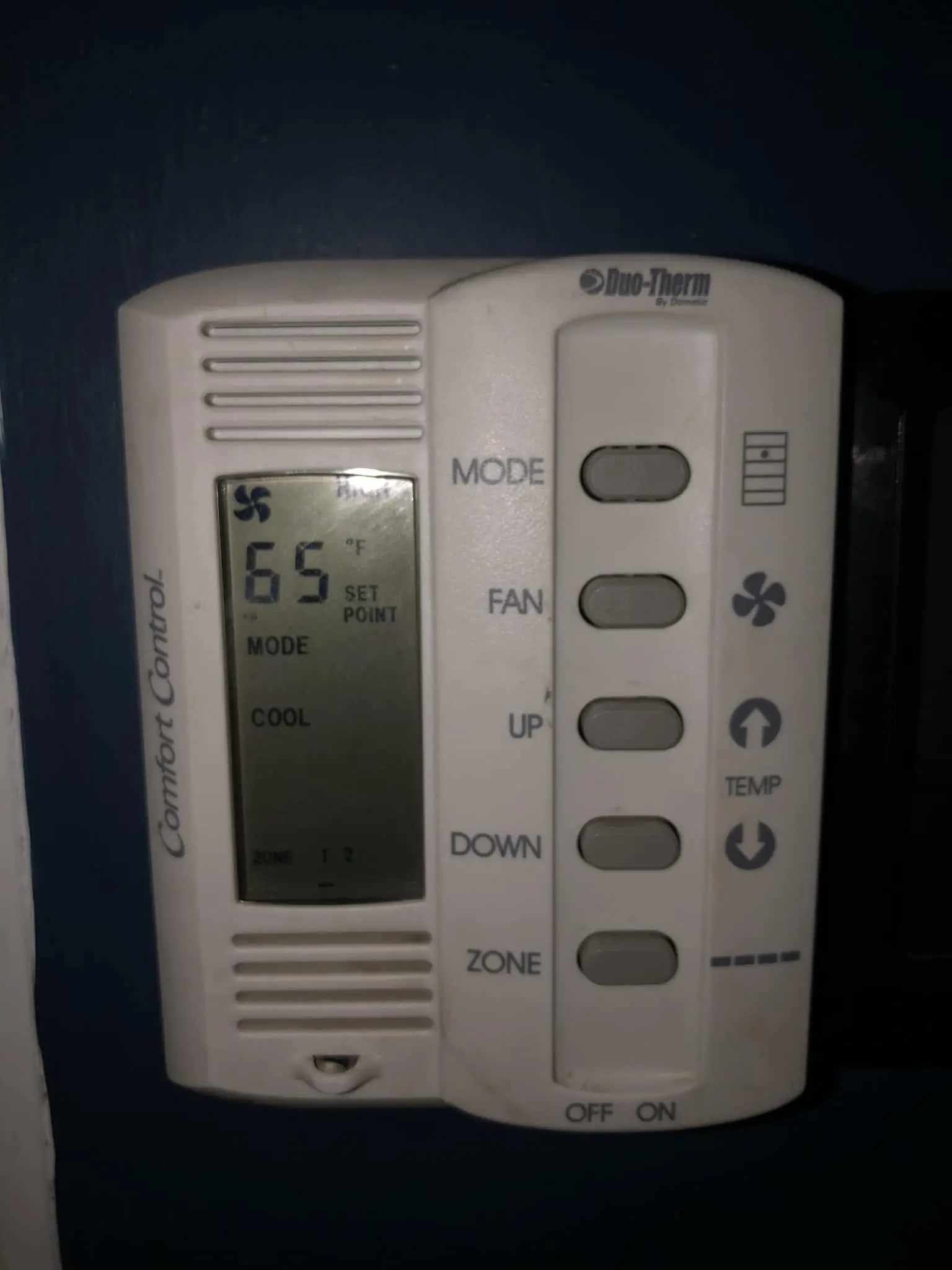
The Duo-Therm Comfort Control Center runs all of an RV's air conditioning and gas heating appliances from one wall-mounted panel. It uses four push-buttons: MODE, FAN, UP and DN. The power switch is a lever on the lower right edge. The display adapts to each installation, so it only shows the modes and fan options that match the equipment actually connected to the vehicle. Pressing MODE repeatedly steps through every available selection, which is a quick way to see what your system supports.
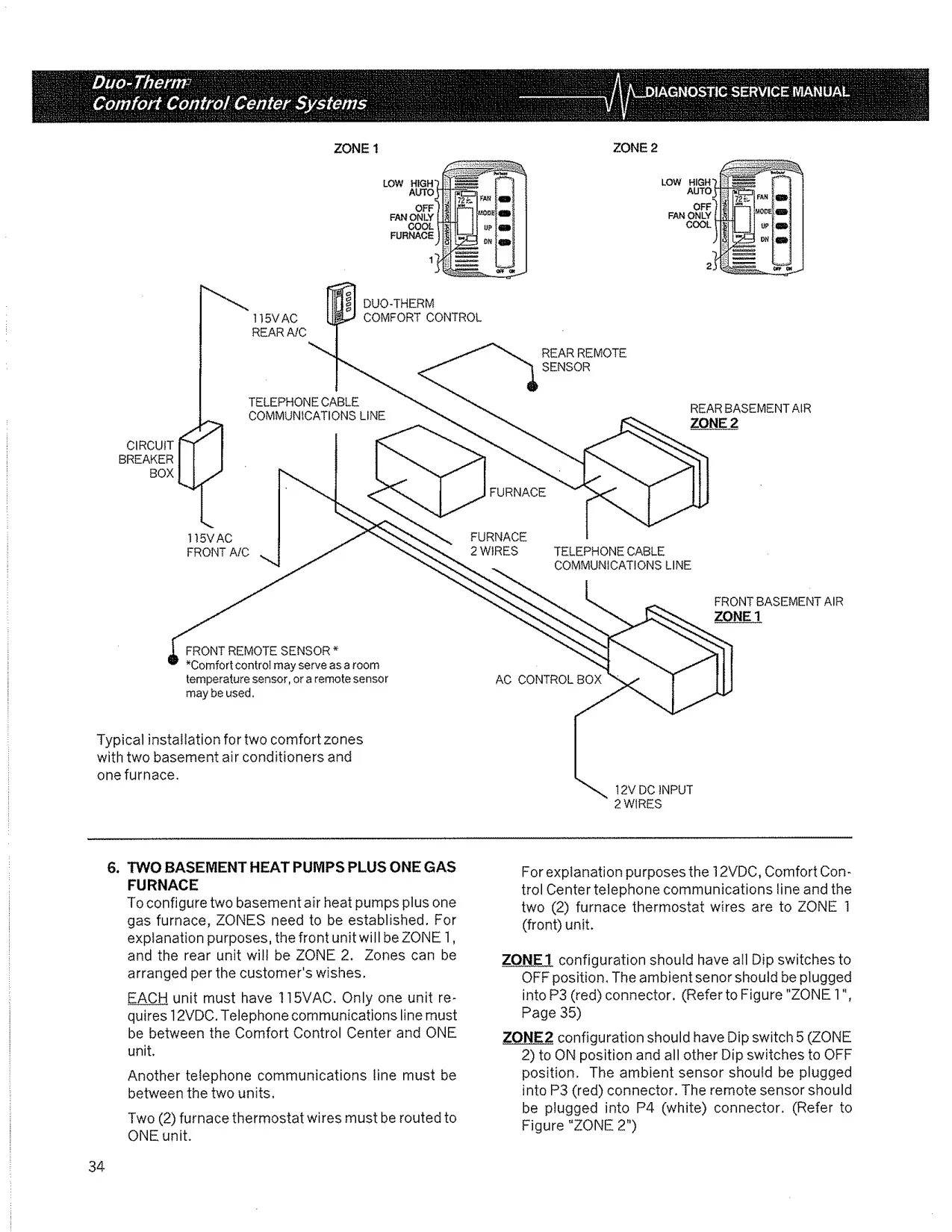
Each zone can be set up on its own. Pressing FAN and MODE together moves from one zone to the next, and the LCD shows which zone you are editing. For example, you could keep the rear bedroom cooler than the front living area. As a safety interlock, the control will not run FURNACE together with COOL or HEAT PUMP. When furnace mode is chosen in any zone, all air conditioner and heat pump units stop running.
In AUTO, the control picks the fan speed itself. In COOL mode on standard units, the fan runs HIGH when the room is 8° or more from the set-point, MED between 4° and 8°, and LOW at 4° or less. Heat pumps and dual basement units use only two steps: HIGH above a 4° difference and LOW below it. In HEAT STRIP and FAN ONLY modes, AUTO keeps the fan on LOW. HIGH speed cannot be selected at all while the heat strip is running.
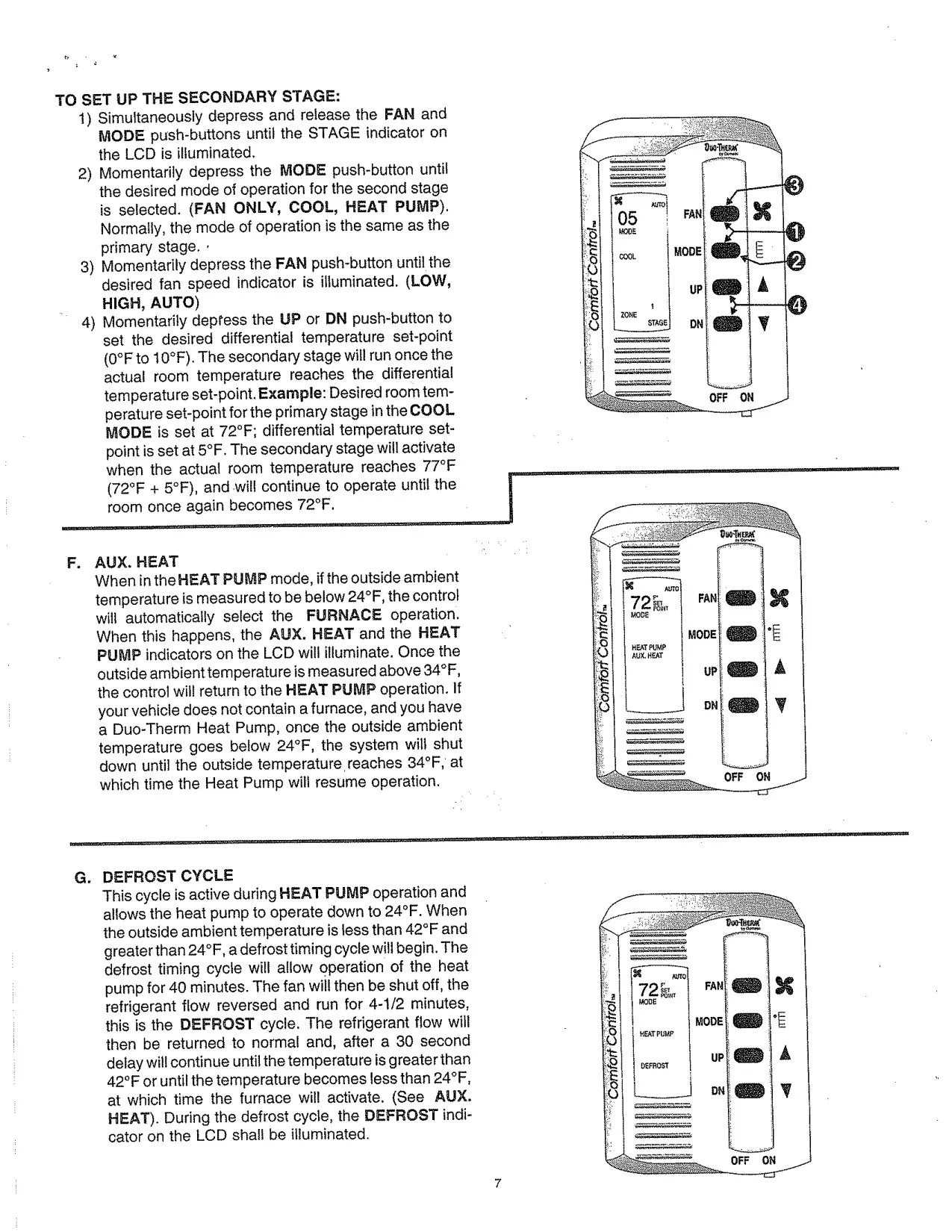
Stage control applies to dual basement air conditioners and heat pumps, which are two units wired in series. The second stage is set up through the STAGE indicator. It turns on when the room drifts past the primary set-point by the chosen differential. For example, with cooling set to 72°F and a 5°F differential, the second stage starts at 77°F and runs until the room is back at 72°F. If there isn't enough electrical power for the second stage, the primary stage keeps running.
The control saves your settings. After a power interruption, the system restarts with the same settings it had before. If the panel acts up or shows incomplete data, a reset returns it to factory settings. To reset: hold UP and DN, press MODE once, release UP and DN, then press MODE again. The light should go out and the mode should read OFF. A reset erases all programmed memory.
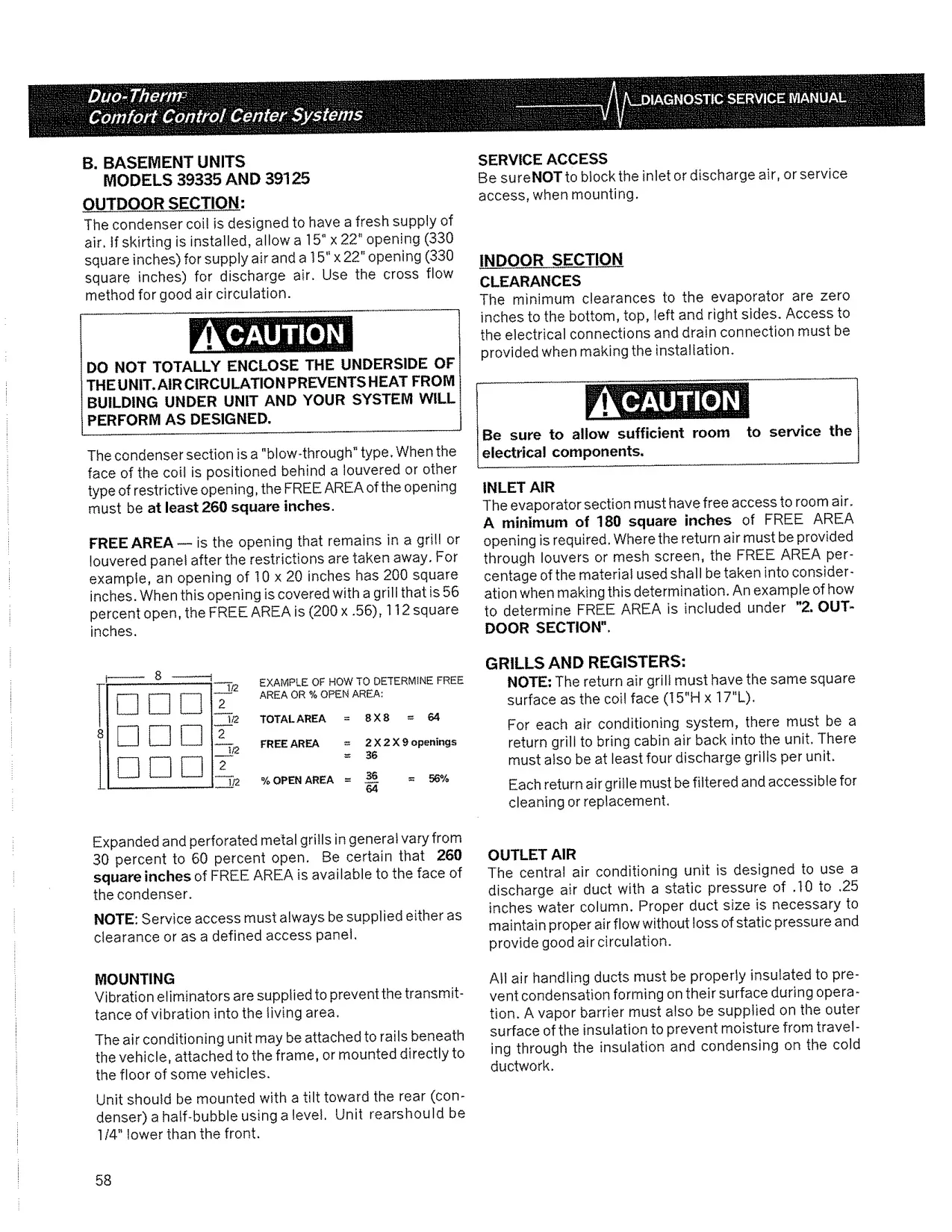
If no remote sensor is used, the control also acts as the room temperature sensor, so where you mount it matters. Put it on an interior partition, not an outside wall. Keep it away from lamps, direct sun, outside doors, windows and supply registers. If every zone has a remote sensor, the panel can go anywhere convenient. Remote sensors follow the same placement rules, and they should also avoid spots with stagnant air, such as under cupboards.
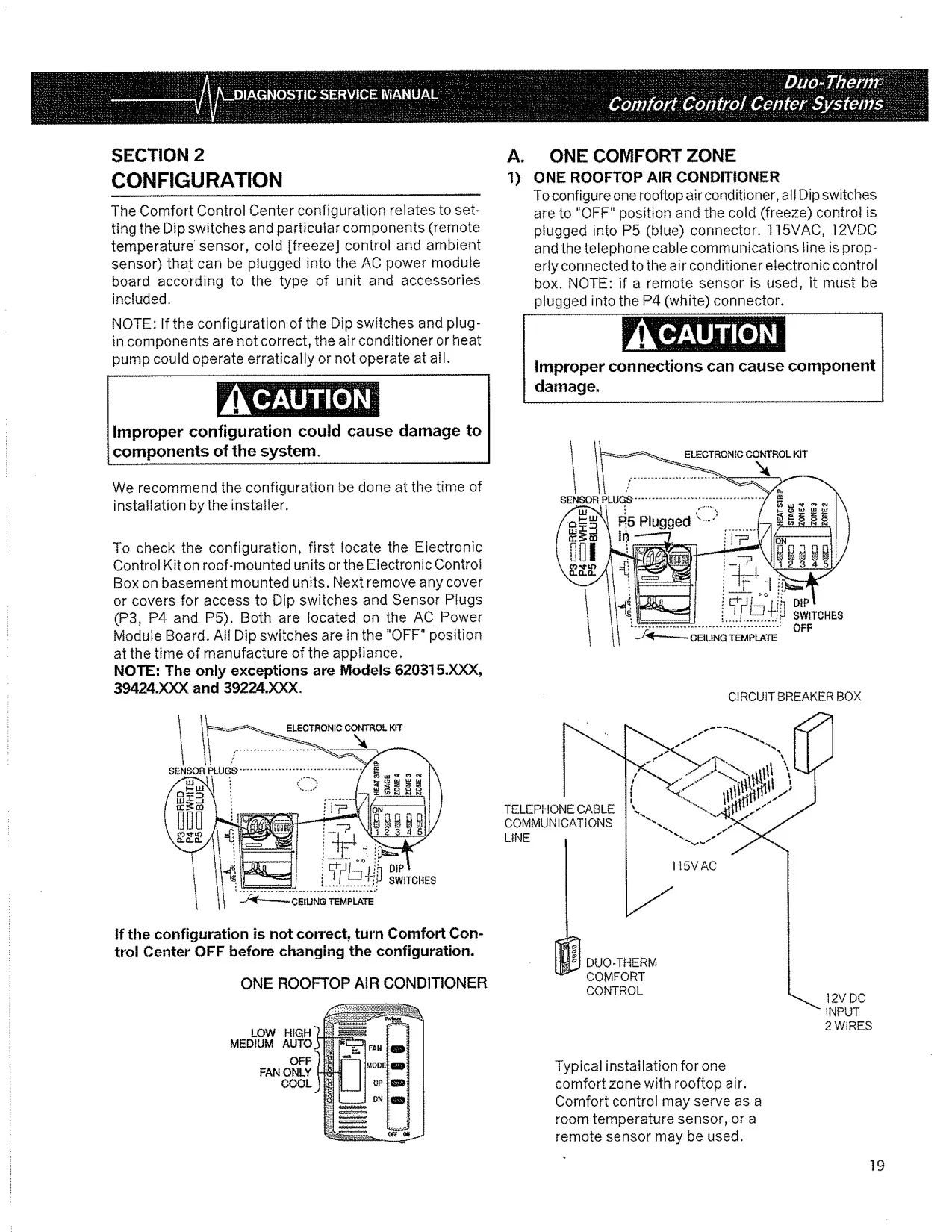
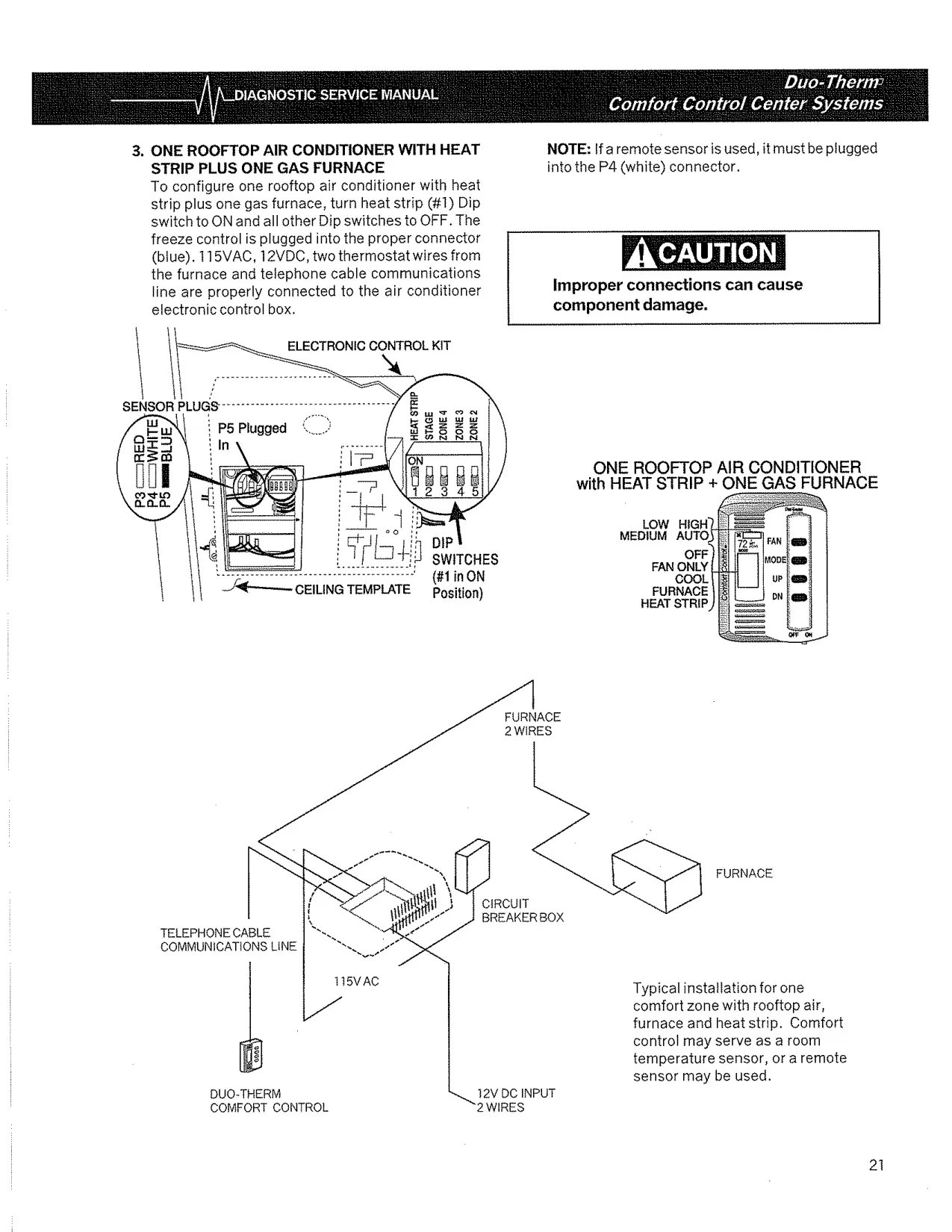
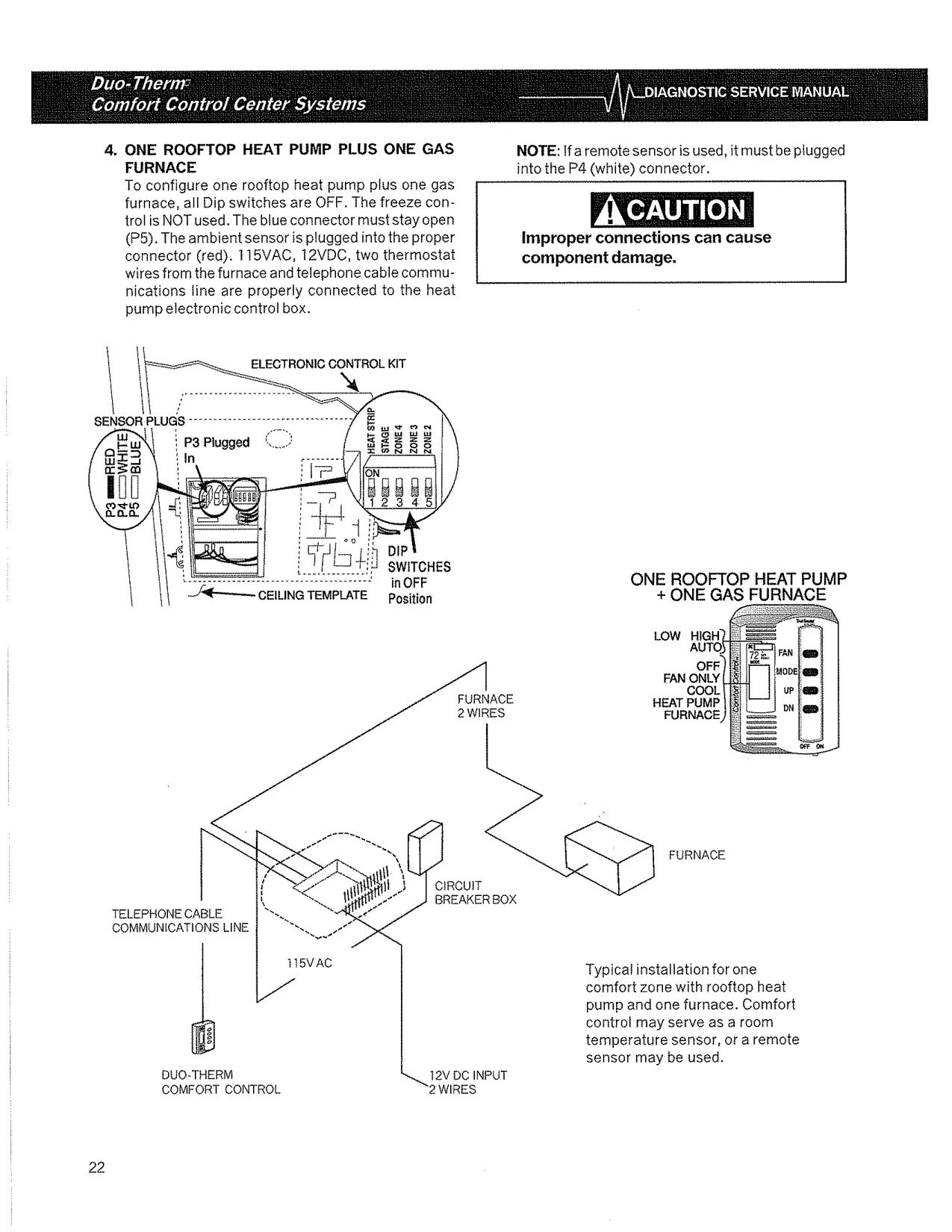
The communication cable must be built from bulk modular cable with an RJ-11 crimping tool, with the black wire on the left when viewed from the clip side. The manual warns never to use a pre-made telephone extension cable: its connector polarity is reversed and will cause a system failure. Incorrect Dip switch or sensor plug settings can cause erratic operation or damage components.
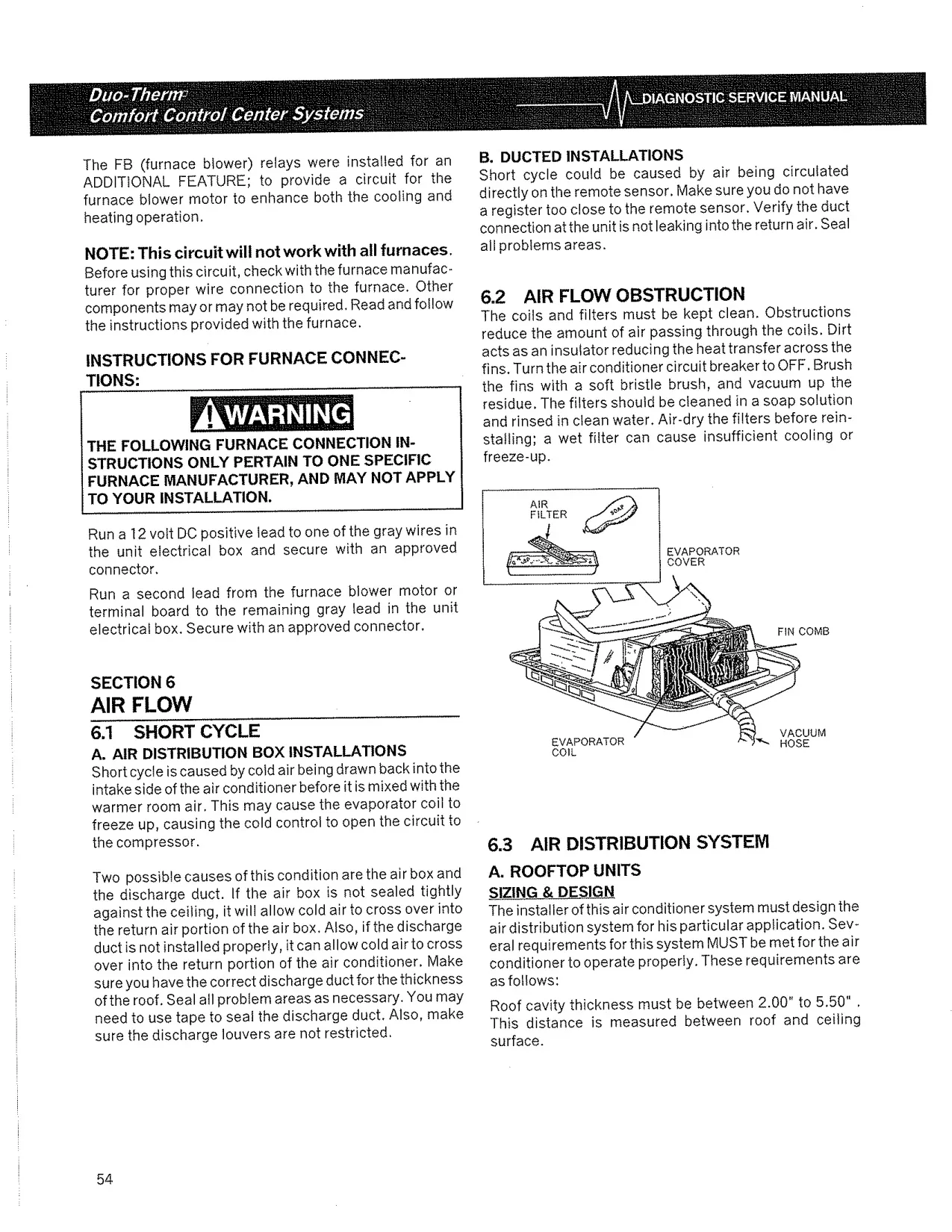
To keep the system working well, clean the panel with a moist, soft cloth and never use solvents. Wash the return air filter regularly with soap and warm water, and never run the unit without it. To reduce heat gain, park in the shade, close the blinds, keep doors shut, limit heat-producing appliances, and start cooling early in the morning so the unit gets a head start.
Frequently Asked Questions (FAQs)
Can't find the answer you need? Here are some frequently asked questions about the Duo Therm RV Thermostat, and we answer them below.