Nikon FM2 Analog SLR Camera Instruction Manual
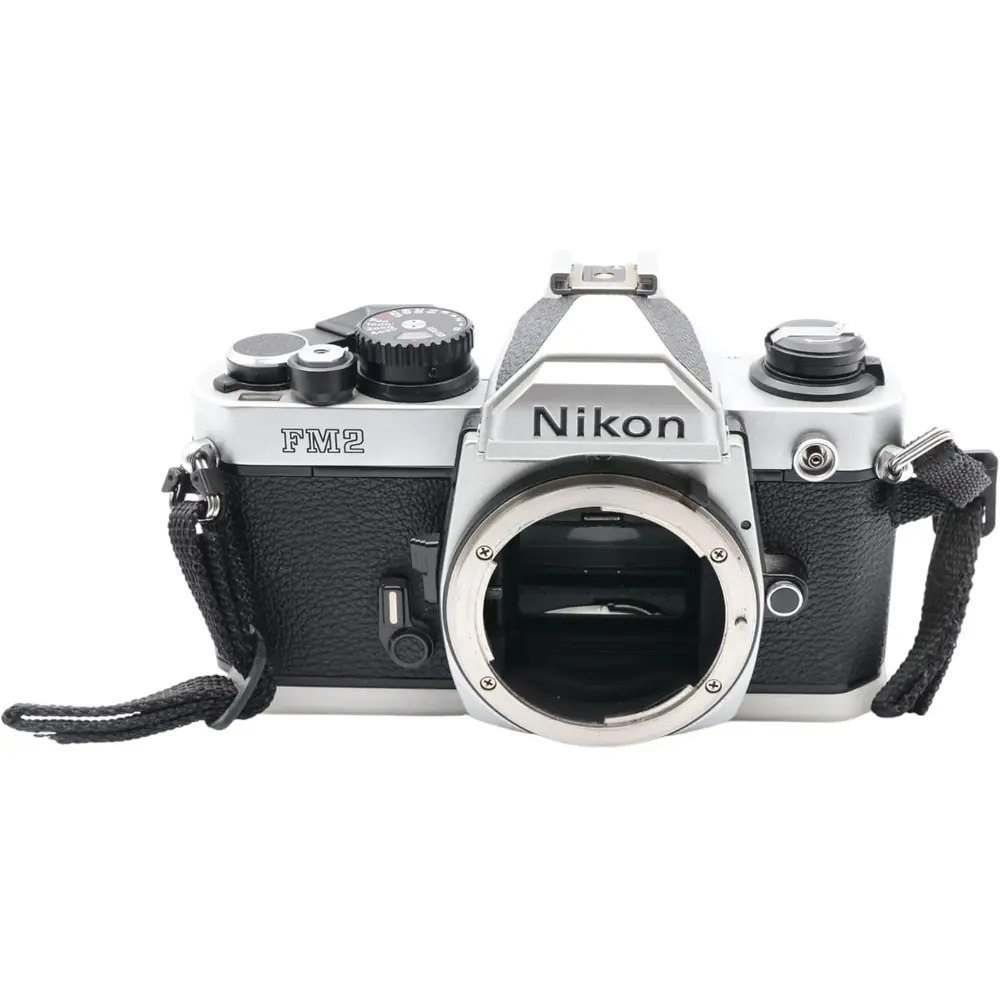
Nikon FM2 Analog SLR Camera


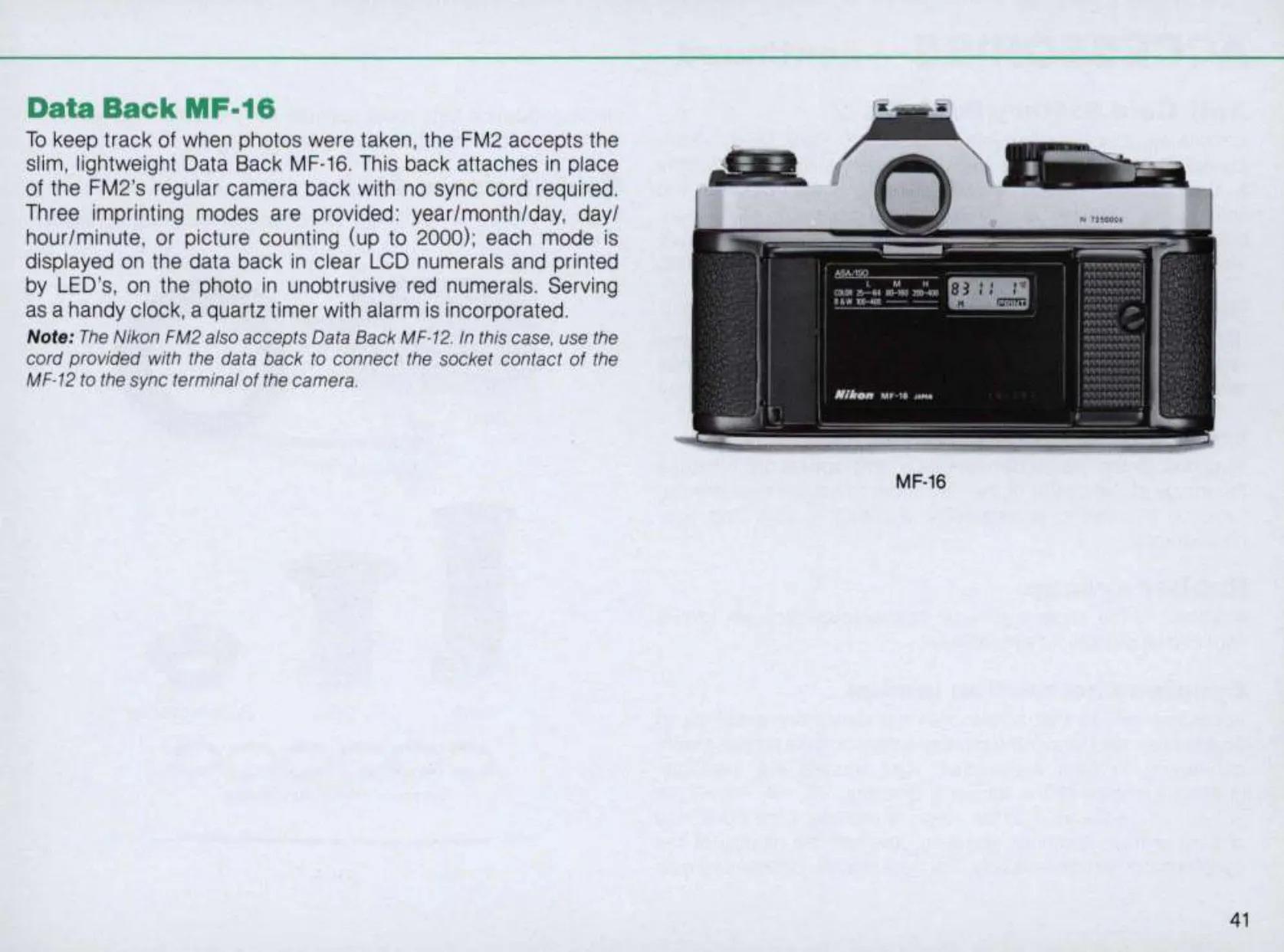




Nikon FM2 Analog SLR Camera Instructions
Here we offer the Nikon FM2 Analog SLR Camera manual completely free and in English. We have cataloged this manual in the SLR Cameras section on Manualverse, and it has been rated by 1 users with an average rating of 5. If you have any specific questions about Nikon FM2 Analog SLR Camera, we suggest checking the Frequently Asked Questions (FAQs) section of this manual.
Product Images


Nikon FM2 Analog SLR Camera Specifications
| Feature | Description |
|---|---|
| Type of camera | 35mm single-lens reflex (SLR) focal plane shutter camera |
| Usable film | Any cartridge-type 35mm film |
| Picture format | 24mm x 36mm |
| Lens mount | Nikon F bayonet mount |
| Shutter | Vertical-travel, metal focal plane shutter |
| Shutter speed settings | 1 sec. - 1/4000 sec., B (bulb); 14 fixed settings in all |
| Self-timer | Set/cancel type provided; approx. 10-sec. shutter release delay |
| Viewfinder | Eye-level type, with 93% frame coverage |
| Viewfinder display | Shutter speed, f/number, and LED exposure display for overexposure (+), correct exposure (o), and underexposure (-) |
| Focusing screen | Split-image microprism type (Type K2) provided as standard; matte type (B) and matte with horizontal and vertical line etchings (E) optionally available. |
| Mirror | Quick-return type |
| Film advance | Lever provided; 30° standoff angle and 135° winding angle |
| Automatic film advance | Possible with optional Motor Drive MD-12 |
| Multiple exposure lever | Provided, disengages frame counter for correct count |
| Frame counter | Additive type (S, 0...36); automatically resets to S when camera back is opened |
| Film rewind | By crank provided after film rewind button is pressed |
| Flash synchronization | Built-in hot shoe for mounting flash unit; sync cord terminal also provided; 1/250 sec. sync |
| Ready-light | Provided inside the viewfinder |
| Exposure meter | TTL center-weighted full aperture exposure measuring system using a pair of SPDs (silicon photodiodes) as photoelectric element; measures from EV1 to EV18 at ASA/ISO 100 and with 50mm f/1.4 lens (i.e., from 1 sec. at f/1.4 to 1/4000 sec. at f/8) |
| Film sensitivity range | ASA/ISO 12 - 6400 |
| Power source | Choice of one 3V lithium battery, two 1.55V silver-oxide batteries, or two 1.5V alkaline-manganese batteries |
| Exposure meter switch | Light pressure on shutter release button switches meter on; meter stays on for approx. 30 sec. after finger leaves button, then automatically switches off |
| Battery power check | LED exposure display inside viewfinder lights up when the exposure meter is switched on if there is sufficient power (i.e., the shutter speed dial should be set anywhere except B) |
| Camera back | Pops open when the film rewind knob as the camera back lock is pushed; detachable; memo holder provided. |
| Dimensions (W x H x D) | Approx. 142.5mm x 90mm x 60mm or 5.6 x 3.5 x 2.4 in. (camera body only) |
| Weight | Approx. 540g or 19 oz. (camera body only) |
Nikon FM2 Analog SLR Camera Details
The Nikon FM2 offers an intuitive manual control layout. Key physical controls include a prominent shutter release, depth-of-field preview, and self-timer levers. Direct tactile control over focusing, aperture, and shutter speed is provided via dedicated rings and dials. Practical features like a film rewind knob with a crank, a film plane indicator, and a memo holder on the detachable camera back enhance usability, ensuring a classic, hands-on photographic experience focused on efficiency.
Beyond its precise TTL center-weighted metering, the manual offers crucial insights for specialized exposure scenarios. For high-contrast copywork, using an 18% reflectance gray card is recommended for accurate exposure without compensation. When duplicating documents, specific compensations are advised: +1 to +2 stops for black letters on white, or -1/2 to -1 stop for white letters on black, ensuring faithful reproductions in challenging lighting.
The FM2's versatility extends to advanced techniques such as slide duplication and photomicrography. For slide duplication, specialized accessories like the Nikon Slide Copying Adapter PS-6 and Bellows Focusing Attachment PB-6 are essential. In photomicrography, with the Microflex PFX, a starting exposure compensation of approximately +1 stop is suggested. The manual emphasizes test shooting for fine-tuning, noting that more exposure often yields better microscopic results.
Film handling is straightforward, featuring an additive frame counter that automatically resets upon camera back opening. Film rewind is facilitated by a dedicated button and integrated crank. For faster shooting sequences, the FM2 supports the optional Motor Drive MD-12. This accessory connects via specific couplings, transforming the manual advance into a semi-automated system, greatly increasing shooting speed and convenience for dynamic subjects.
The camera integrates widely with various Nikon Speedlights via its hot shoe or sync cord terminal. The manual details compatibility for units like the SB-24, SB-26, and SB-28, which offer auto, manual, and even repeating flash modes. Older units, such as the SB-10 or Ringlight Unit BR-2, can also be used, often requiring specific couplers or extension cords. This broad compatibility ensures diverse lighting options for any photographic scenario.
While the standard Type K2 split-image microprism focusing screen is effective, the FM2 offers customizable alternatives. The Type B matte screen is ideal for close-up or telephoto work. The Type E screen with etched lines is invaluable for precise composition, especially with PC-Nikkor lenses. Importantly, certain Fisheye-Nikkor lenses are unusable, and specific serial numbers of PC-Nikkor, Reflex-Nikkor, and Zoom-Nikkor lenses have limitations due to mechanical interference.
Frequently Asked Questions (FAQs)
Can't find the answer you need? Here are some frequently asked questions about the Nikon FM2 Analog SLR Camera, and we answer them below.