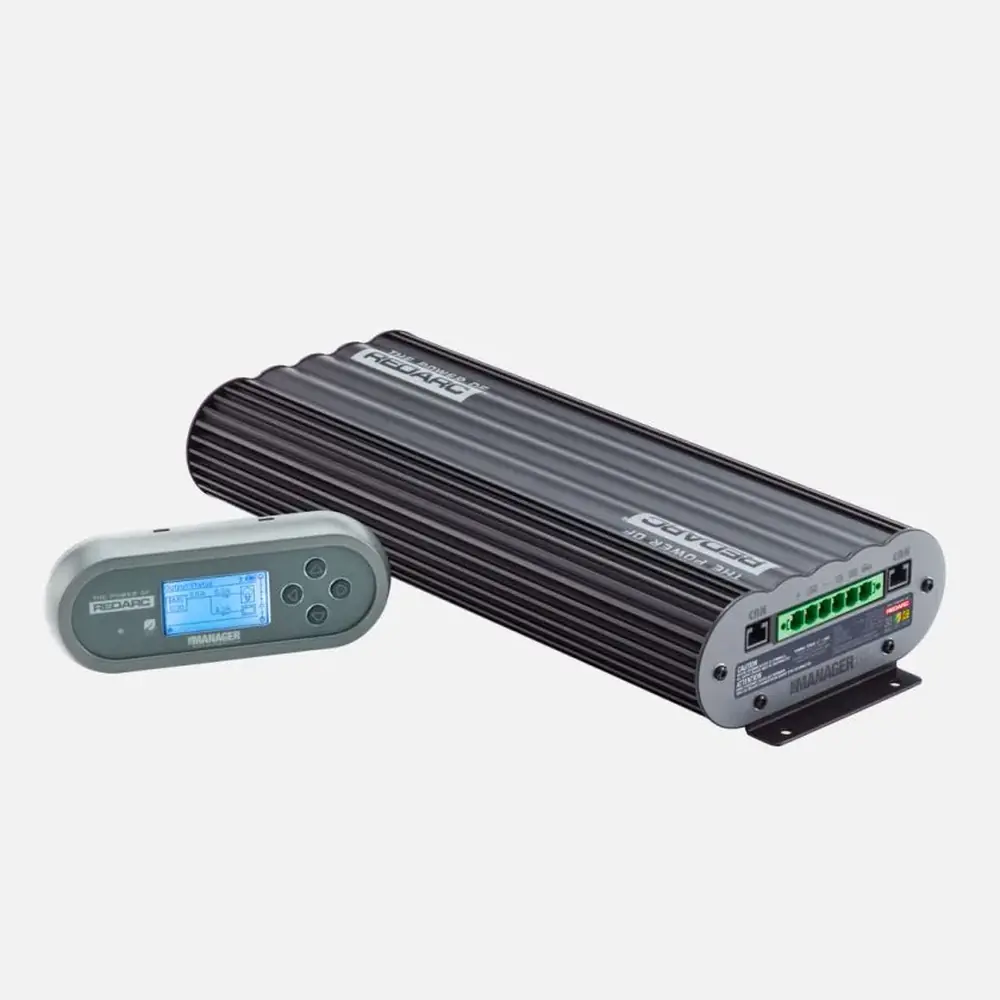
Redarc BCDC1225D Battery Charger Instruction Manual

Redarc BCDC1225D Battery Charger










Redarc BCDC1225D Instructions
Here we offer the Redarc BCDC1225D Battery Charger manual completely free and in English. We have cataloged this manual in the Battery Chargers section on Manualverse, and it has been rated by 1 users with an average rating of 5. If you have any specific questions about Redarc BCDC1225D Battery Charger, we suggest checking the Frequently Asked Questions (FAQs) section of this manual.
Product Images


Redarc BCDC1225D Battery Charger Specifications
| Feature | Specification |
|---|---|
| Part Number | BCDC1225D |
| Product Type | Dual Input Multi-stage 12V In-vehicle DC-DC Battery Charger with MPPT Solar Regulator |
| Continuous Current Rating | 25A |
| Output Power | 375W |
| Vehicle Input Fuse Rating | 40A (not supplied) |
| Output Fuse Rating | REDARC FK40 recommended |
| Vehicle Input Voltage Range | 9-32V (12V or 24V alternator systems) |
| Solar Input Voltage Range | 9-32V (unregulated solar panels only, 12V nominal) |
| Output Battery Type | Standard Lead Acid, Calcium Content, Gel, AGM or LiFePO4 |
| Charging Profile A - Maximum Voltage | 14.6V |
| Charging Profile B - Maximum Voltage | 15.0V |
| Charging Profile C - Maximum Voltage | 15.3V |
| Charging Profile Li - Maximum Voltage | 14.5V |
| Float Voltage (Profiles A, B, C) | 13.3V |
| Float Voltage (Profile Li) | 13.6V |
| Voltage Tolerance | ±100mV |
| Charging Stages | 3 (Boost, Absorption, Float) |
| No Load Current | <100mA |
| Standby Current | <8mA |
| Minimum Output Battery Voltage | 4.2V |
| Peak Current on Heavy Gauge Wires | Up to 35A |
| Operating Temperature | -10°C to 80°C / 14°F to 175°F |
| Recommended Cable (1-5 m / 3-16 ft) | 7.71 mm² (8 B&S / AWG) |
| Recommended Cable (5-9 m / 16-30 ft) | 13.56 mm² (6 B&S / AWG) |
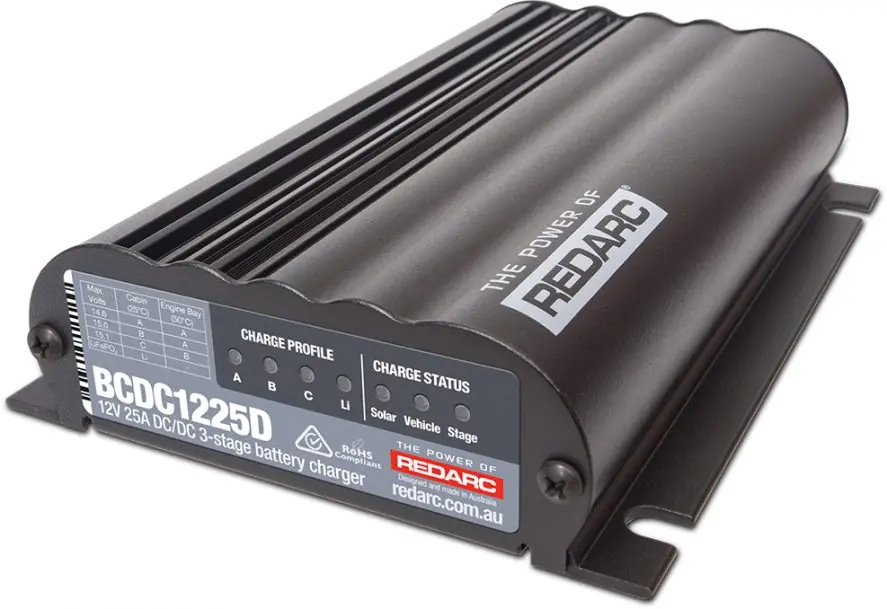
| Display | 7 LEDs (charge profile and charge status) |
| Weight | 1 kg |
| Dimensions | 165 x 120 x 37 mm |
| Standards | CISPR11, ECE Reg. 10 |
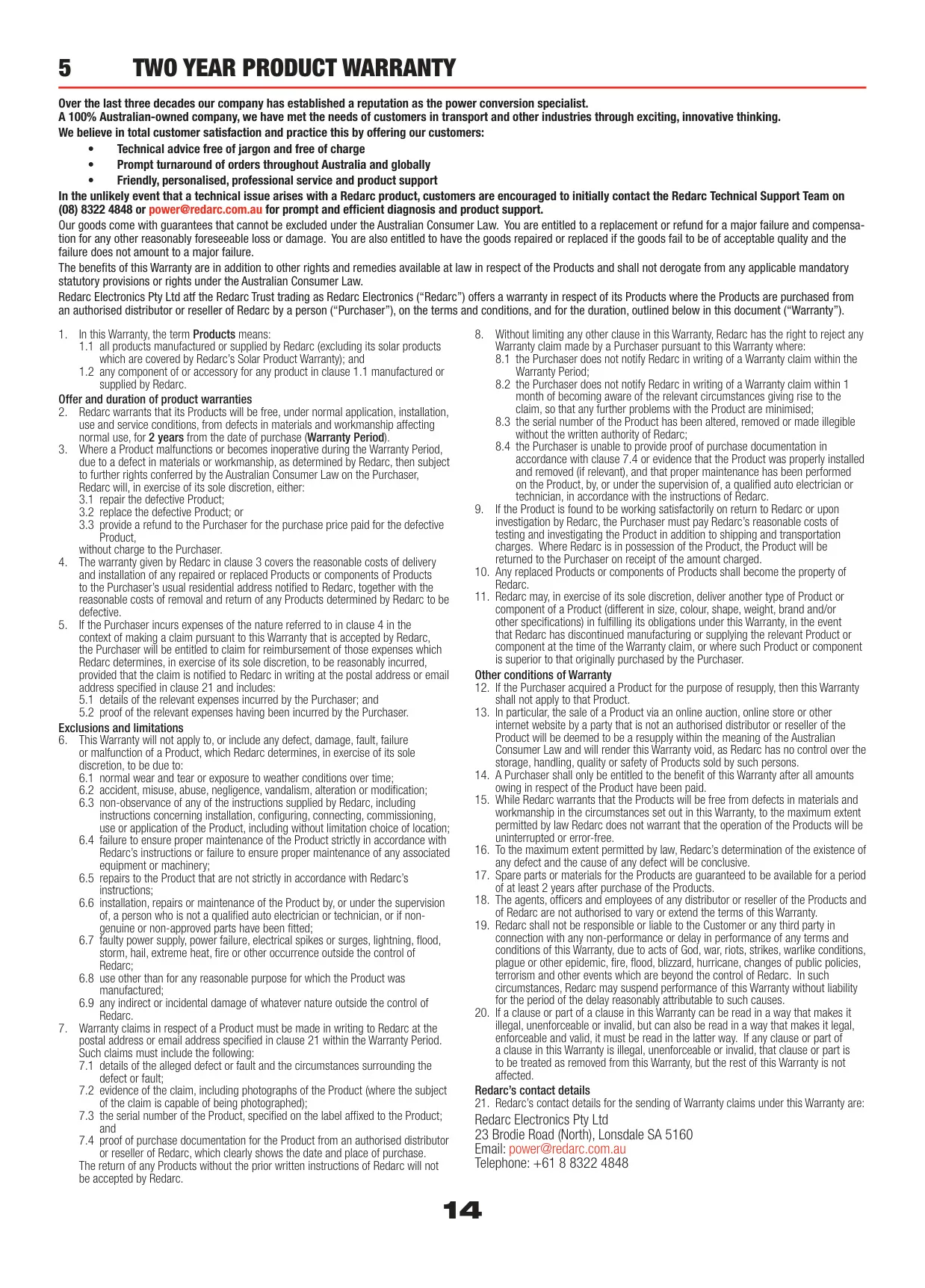
| Warranty | 2 years |
Redarc BCDC1225D Battery Charger Details
The Redarc BCDC1225D is a three-stage DC-DC charger that runs from a 12V or 24V alternator and from an unregulated 12V nominal solar panel. It can both step voltage down and boost it up, so the input can be above, below or equal to the output voltage. That makes it a good fit where a long cable run to the auxiliary battery causes a large voltage drop. The unit also isolates the main battery from the auxiliary battery, which stops the starting battery from being over-discharged.
The charger uses Green Power Priority technology. It draws as much power as possible from the solar input before topping up from the vehicle input, up to its rated output or whatever the battery needs. The Solar and Vehicle LEDs show which sources are available and in use. The charger also works with a single source: as a stand-alone solar regulator with only the YELLOW wire connected, or as a DC charger with only the RED wire connected.
Charging starts in the Boost stage, which holds a constant current until the battery reaches its absorption voltage. The current may drop during this stage to keep the unit at a safe temperature or to limit the difference between input and output voltage. The Absorption stage then holds a constant voltage for a set time, or until the battery draws less than 4A for 30 seconds. Float keeps the battery topped up and goes back to Boost when the battery loses charge. The Stage LED shows each stage with its own flash pattern.
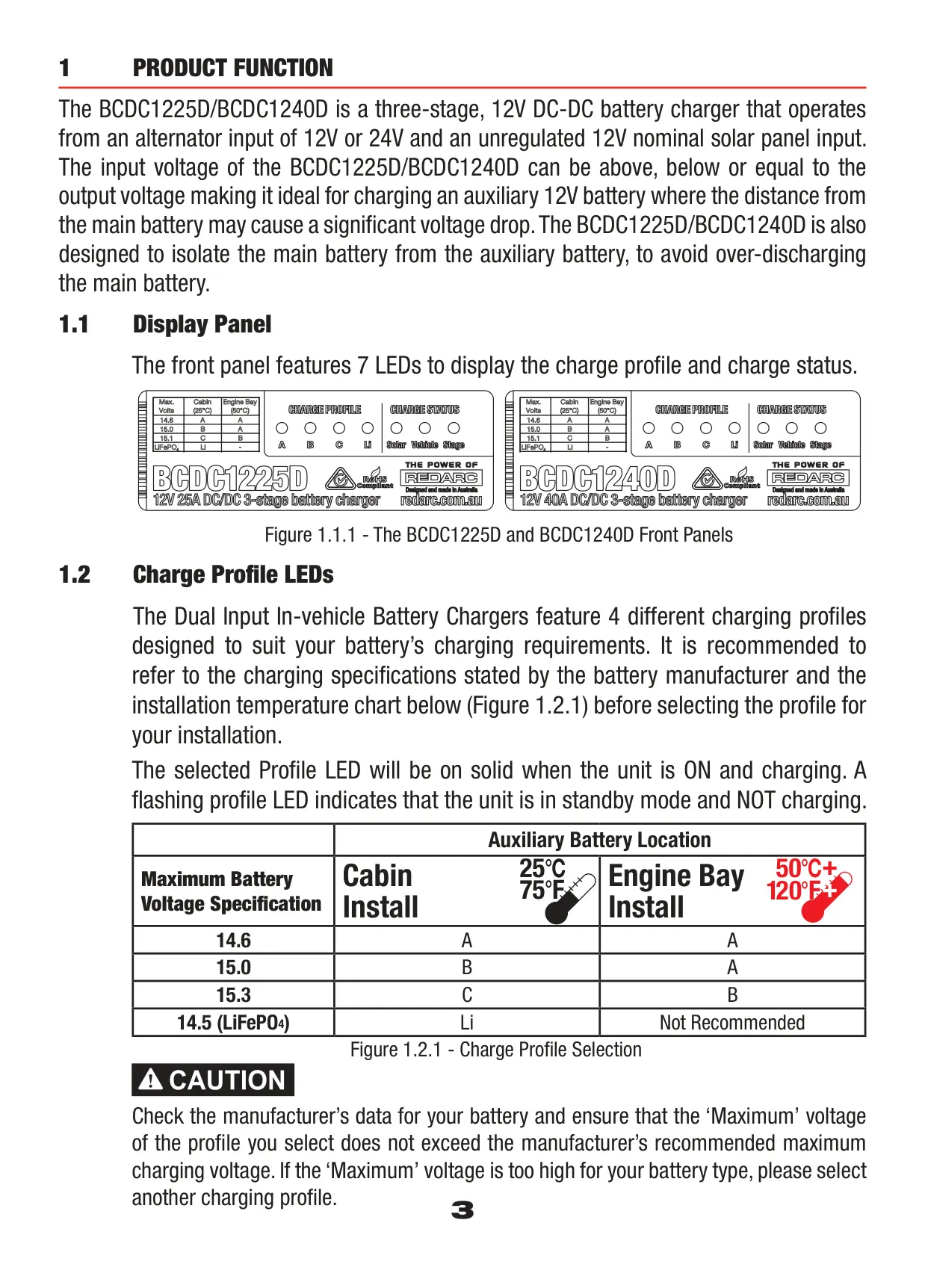
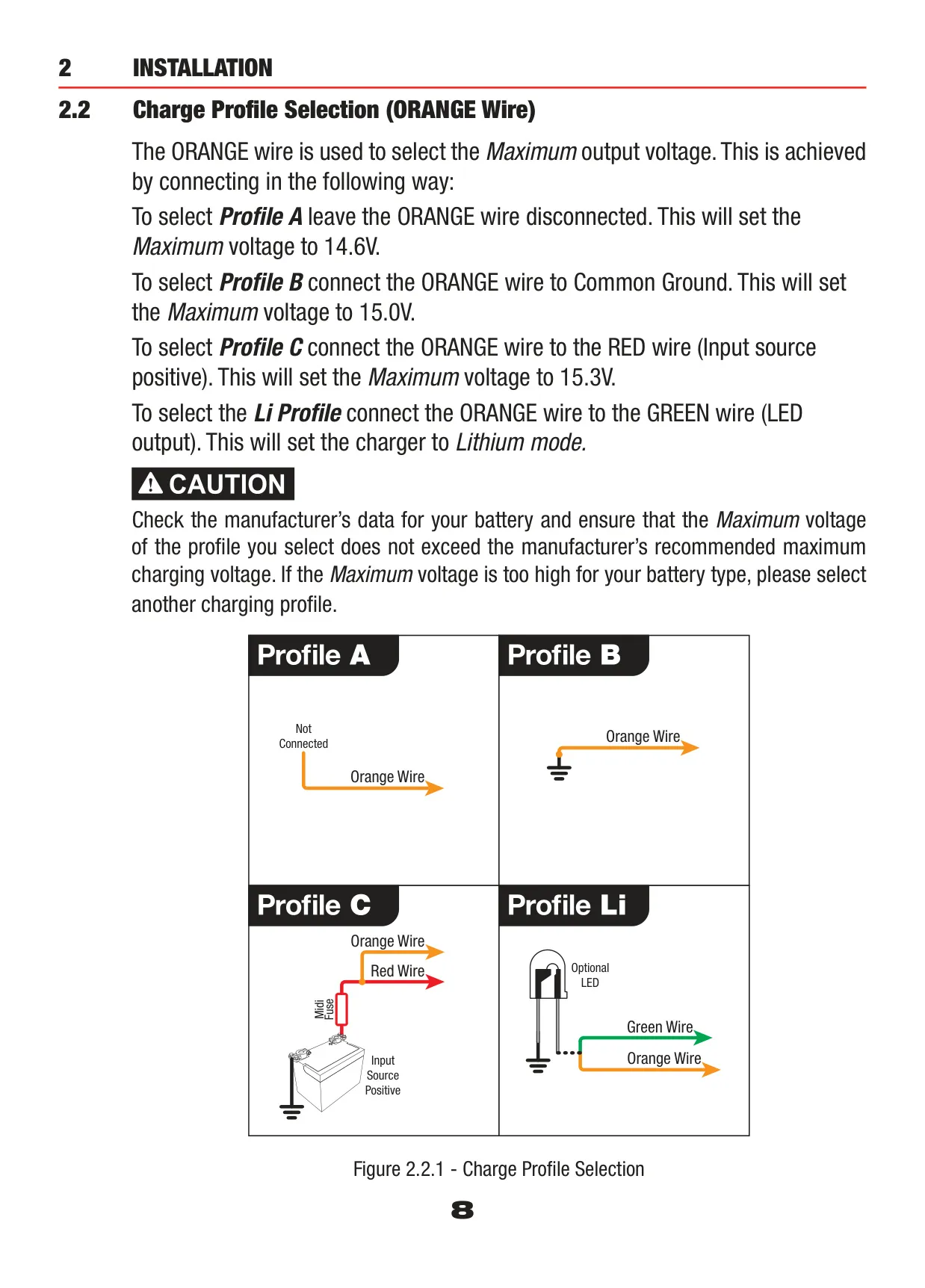
You choose the charge profile with the ORANGE wire. Leave it disconnected for Profile A, connect it to ground for Profile B, connect it to the RED wire for Profile C, or connect it to the GREEN wire for Lithium mode. A solid profile LED means the unit is charging, and a flashing one means standby. Redarc's temperature chart suggests dropping one profile for engine bay installs and advises against lithium batteries in engine bays.
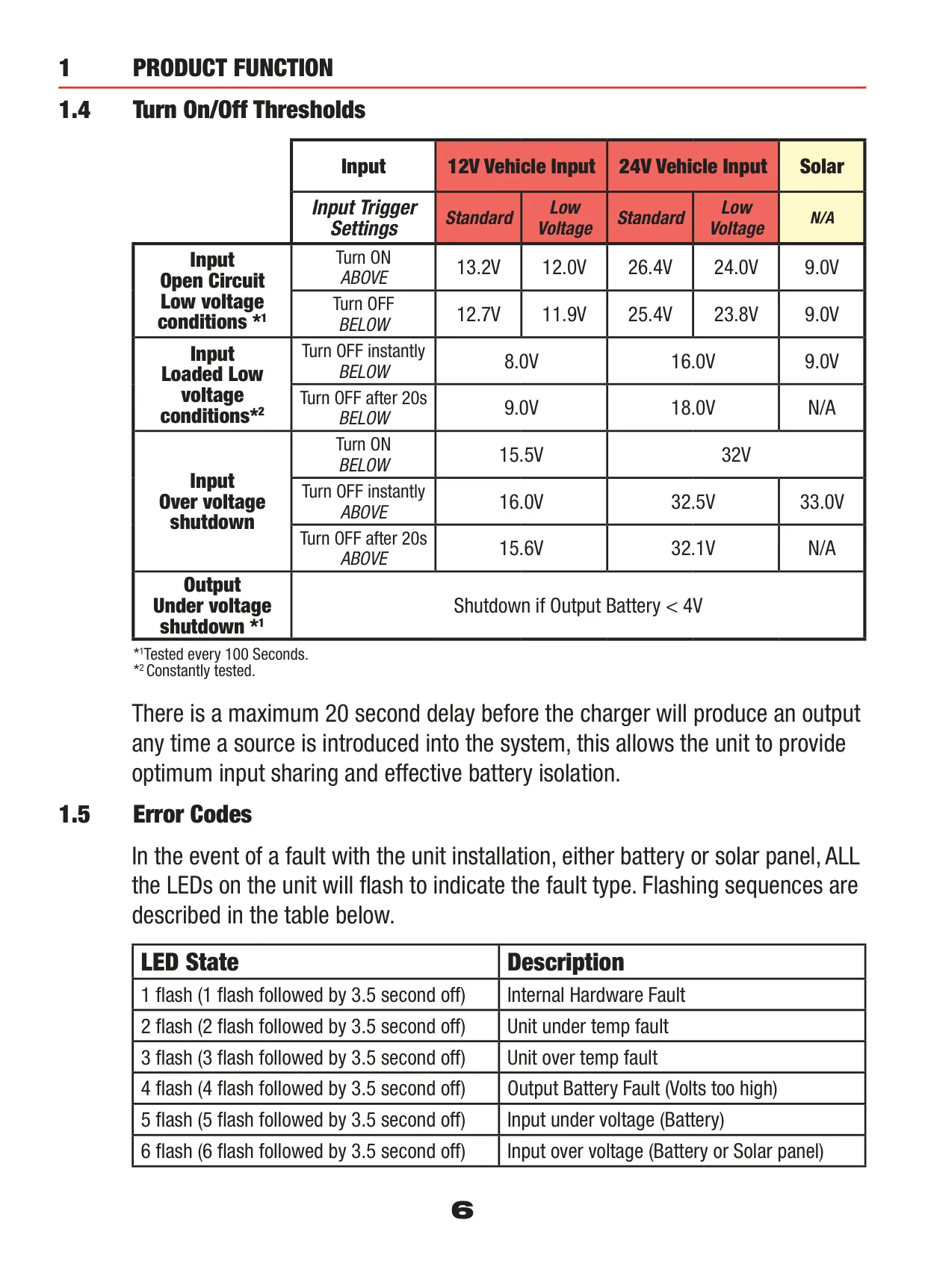
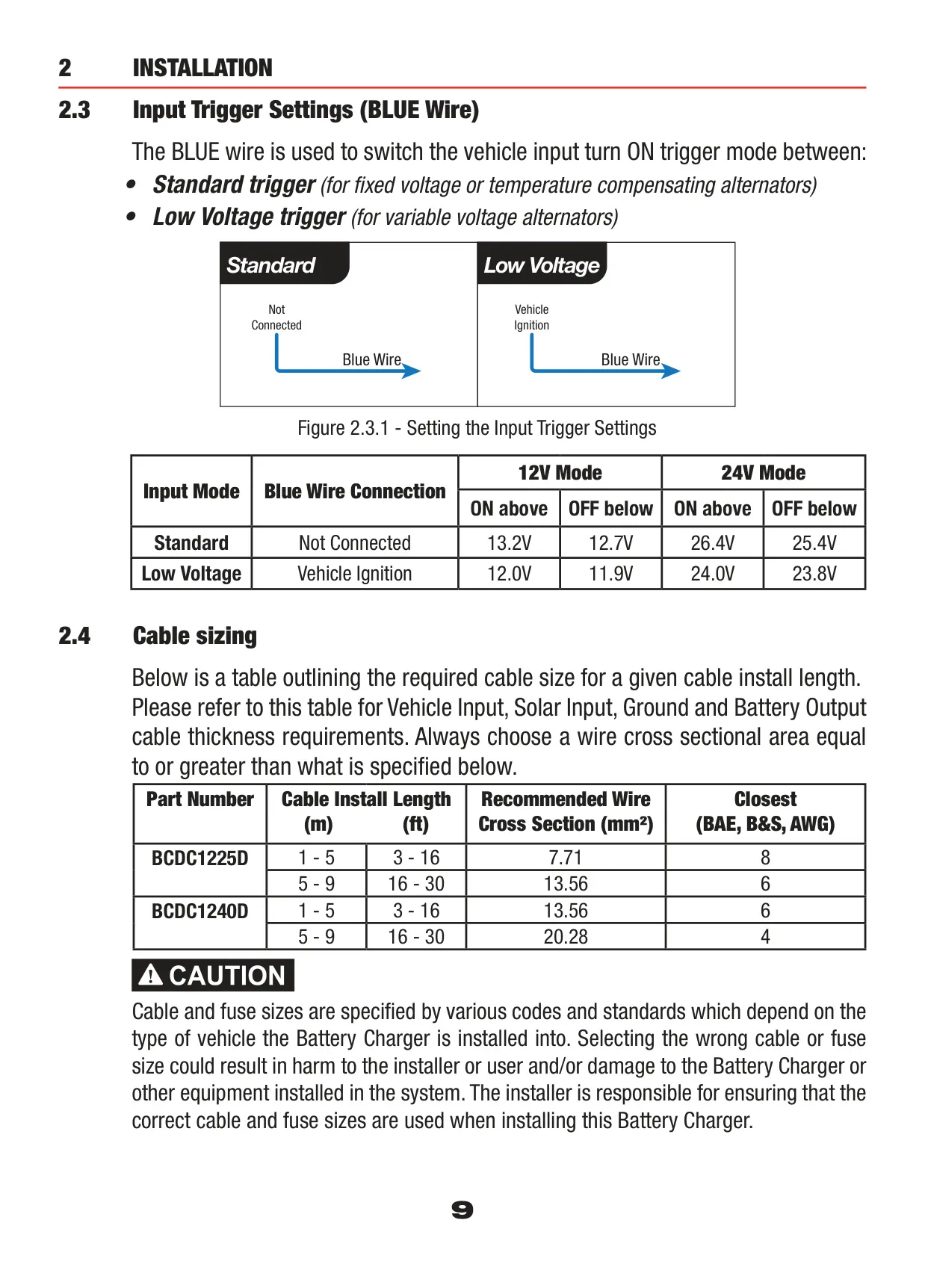
The BLUE wire sets the vehicle input trigger. If you leave it disconnected (Standard trigger, for fixed-voltage alternators), the unit turns on above 13.2V and off below 12.7V, or 26.4V and 25.4V on 24V systems. If you connect it to ignition (Low Voltage trigger, for variable-voltage alternators), the thresholds are 12.0V and 11.9V, or 24.0V and 23.8V. The unit shuts down instantly above 16.0V (12V input), 32.5V (24V input) or 33.0V (solar). It also waits up to 20 seconds before charging whenever a new source is connected.
Every 100 seconds, a battery test mode checks that the input conditions are still met and that a battery is still connected to the output. In low-current conditions such as float, the test can take up to 60 seconds. When there is a fault, all LEDs flash in a repeating pattern of 1 to 6 flashes followed by 3.5 seconds off. The patterns indicate an internal hardware fault, under-temperature, over-temperature, output battery voltage too high, input under-voltage or input over-voltage. You can also wire in an optional external 3V LED (not a 12V LED) to see status remotely.
The unit can be mounted in the cabin, on a chassis rail or in the engine bay, as close as possible to the auxiliary battery, using the four heatsink mounting tabs. It runs best below 55°C/130°F with good airflow. Above that it reduces output current, and it shuts off at 80°C/175°F. Redarc recommends soldered butt splice crimp connections covered with heatshrink, and MIDI bolt-down fuses. It advises against blade fuses and self-resetting circuit breakers.
Frequently Asked Questions (FAQs)
Can't find the answer you need? Here are some frequently asked questions about the Redarc BCDC1225D Battery Charger, and we answer them below.